Complexity often scares us because it seems utterly continuous, chaotic, and infinite. But in the architecture of any system, even the most astonishing, multi-layered complexity is always built from fundamental simplicity: on/off, yes/no, 1/0.
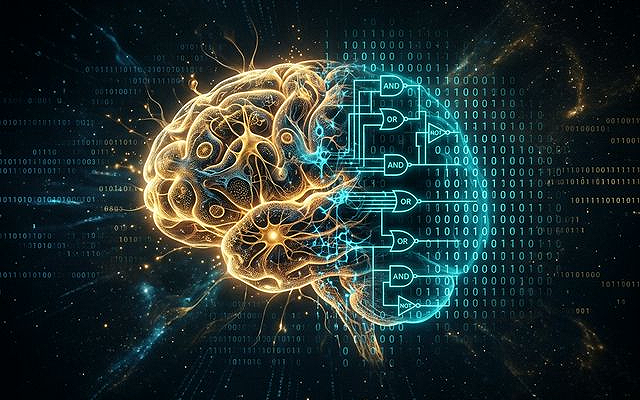
A single switch means nothing by itself—it is only a local change of state. But billions of such switches, assembled into a hierarchy, produce the world we perceive as continuous. And this is not merely a convenient programming analogy. Discreteness and acts of cutoff are deeply built into both the physics of matter and the organization of life.
A Safeguard for the Skeptic
Armor / Important:
When I speak of “ticks of time,” a “network of states,” or “quantization,” I am using a systems lens. Yes, physics includes Planck scales—minimal scales of the physical world—but to treat them literally as pixels on some vast “cosmic monitor” is to drift into science fiction.
In this series, I use the language of IT not to replace rigorous science with a simulation story, but to make the architecture of the microworld tangible and understandable in engineering terms.
01 — The Discreteness of Space: The Universe as a Network of States
There is a temptation to say: “the world is made of pixels that update themselves based on their neighbors”—a familiar image for fans of cellular automata and Conway’s Game of Life. For rigorous science, that claim is still too confident. In General Relativity, space is continuous.
But as a thinking tool, this lens is useful. What if we look at reality not as smooth geometric emptiness, but as a system in which many physical quantities appear discretely, while the continuity we take for granted turns out to be an effect of scale?
Then fundamental “motion” begins to feel different. Not like the infinitely smooth rolling of a ball, but like a sequence of state changes in quantum properties:
- a spin value was X → after interaction, it became Y;
- energy was in a field → then became a detected event.
Armor / Important:
Reality is not a pixelated image on a screen; it is a dynamic distribution of probabilities. But the logic of transition between those probabilities, when a fact is registered, is strictly discrete (it happened / it did not happen). This helps explain how smoothness can be an effect of scale. Basic quantum transitions are discrete, yet the macroscopic flow is experienced as fully continuous.
02 — Time as a Sequence of Updates
At the level of everyday human experience, time feels like a river: it flows, carries things away, ages us, and never asks permission.
But in the language of systems, it is often more useful to hold a different lens in mind: time as a sequence of updates.
- “Now” is the current configuration of the world.
- “Later” is the next configuration after change.
I am not claiming that physical time is actually quantized into rigid “frames” — that remains only a hypothesis in quantum gravity. I am simply using this lens: a system moves steadily from one stable state to another while obeying conservation laws. In that view, time is simply a metric of state change.
03 — The Physical “Bit”: Quantization as Threshold
Here the metaphor almost ends, and physics begins. In the microworld, fundamental things really do come in strict portions (quanta) of levels or actions:
- A photon is a packet of energy. A detector absorbs either a whole photon or none at all. The energy involved in detection is physically quantized, even if the photon itself traveled in a superposition of paths.
- Energy levels (orbitals) in an atom are strictly discrete. An electron can absorb a quantum and jump to the next level, but it physically cannot exist at “level 1.5.”
- When spin is measured along a given axis, only discrete outcomes are possible—conventionally, “up” or “down.”
Quantization creates discrete tiers within the system, and spin is an example of quantum binarity in its clearest form.
Armor / Important:
In many cases, discreteness is exactly what makes macroscopic stability possible.
Discreteness is not the enemy of smooth reality. Here it acts as one of the load-bearing frameworks of a stable world, preventing atoms from falling apart under the slightest random noise.
04 — The Biological “Bit”: Life as Program
If physics is discrete on the lowest floors of the structure, then biology is strikingly “digital” even at its larger-scale nodes. And this is not poetic license from biologists, but an engineering fact.
- Neurons in the brain operate on a strict “all or nothing” principle (the excitation threshold). Either the incoming current exceeds the threshold and triggers an action potential—a spike—or the system returns to zero. This is a good example of threshold-based, almost binary logic in living tissue.
- The genetic code (DNA) is a strict symbolic four-letter notation (A, T, G, C). It is a digital database in which a very small set of basic elements generates an immense, self-reproducing diversity of organic forms.
This creates a powerful architectural rhyme: life is organized in a way that allows it to be described as code executed on a complex chemical medium.
It has strict encoding, rewriting protocols (RNA), reproducibility, error-correction mechanisms, variation, and selection through evolution. The biosphere does not merely grow—it also reproduces, copies, and selects its working forms.
05 — The S/N Audit (Structure vs. Noise)
In the series on the “Law of Solar Energy Consumption,” I introduced the idea of auditing our traffic. Now we can see that discreteness and cutoff are deeply embedded in the physical organization of the world.
If we translate this physical principle to the systemic level of the agent, what we get is not a moral code in the sense of “good/evil,” but a technical audit along the axis of “signal / noise”:
- “1” (Structure / Signal) — when energy and time passing through nodes are assembled into a stable, transferable form. Written code. An understood pattern. A built house. A working algorithm. Something that has locally reduced entropy in informational or physical space.
- “0” (Noise / Decay) — when the resource has been spent, but the trace dissolves into entropic chaos. Empty cycles of social friction. Chaotic reactivity. Dissipated heat that performed no useful work.
Armor / Important:
This is not a physical conservation law—physics does not care whether you heat a house or burn it down. It is an architectural lens. We choose to see structure as a value in the existence of an agent, because it is precisely the accumulation of structure that distinguishes life from dead matter.
In this coordinate system, a day that has passed is not just time, but a sequence of actions with a very specific trace: more structure, or more dissipation. We see only the final trace.
06 — The Limit of Visibility
Even if this picture of discreteness seems powerful and nearly exhaustive, an uncomfortable limit appears beyond it: everything we have discussed so far concerns only a small visible part of the cosmos.
This entire system of rigid discrete states, radiating photons, and biological algorithms — all the “glowing” mechanics we can actually understand — makes up only about 5% of the total density of the Universe. The rest is hidden from all our basic sensors.
Armor / Important:
Next: Dark matter and dark energy. Why 95% of the architecture does not interact with our interface. And what if the cosmos we know, with all its stars, is merely a thin interface layer stretched over a gigantic, invisible backend?