We have unpacked the protocol by which matter is assembled. Now let’s look at the result. How, exactly, do trillions of atoms organize themselves in space to create what we call solids, liquids, and gases?
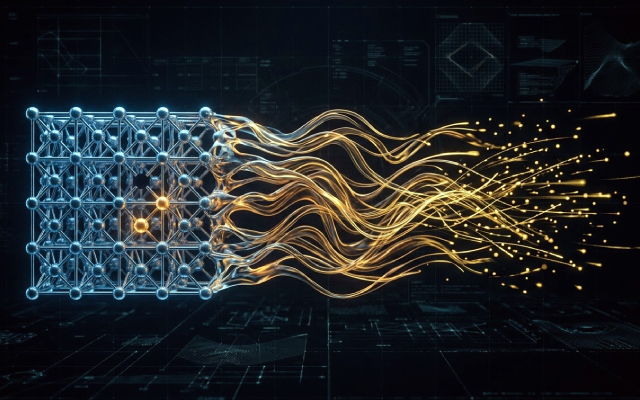
In the classical schoolbook view, a piece of ice, water in a glass, and steam above a kettle are three completely different physical objects. They have different shapes, different densities, different behaviors. You can hold ice in your hand. Water spills and flows. Steam drifts away. But in the architecture of the System, if you look closely, this is the same source code: H₂O molecules. Water. The same substance in three different states of matter. The same program, simply running under different load profiles. Like a single piece of software operating in economy mode, standard mode, or turbo mode.
01—The Safety Catch
Armor / Important:
In this chapter, I will use words like “hardware” and “load profiles.” These are not literal claims. I am not saying that a piece of metal works like a computer motherboard. This is simply a way of speaking—a metaphor. It helps explain one important point.
The properties of matter—hardness, fluidity, elasticity, weight—are not built into it as “magical qualities.” It is not that one piece contains “more hardness” and another “more fluidity.” These properties arise from one thing only: how atoms are packed, how they are connected, and the geometry of their arrangement. This is not magic. It is architecture.
02—Crystals: Order as the Foundation of Stability
When trillions of atoms cool down and align into a strict lattice, something emerges that, in our world, feels like the foundation of stability. That very hardness you can lean on.
A crystal has a fixed structure. A mathematically repeatable geometry. Its atoms are not arranged at random, but in a strict order that can be described by a formula. This gives it an exceptionally high degree of stability. A crystal does not change its shape for no reason—not from a light breeze or an accidental nudge.
But this is where it is important not to oversimplify. Do not picture the schoolbook image in which atoms are nailed to invisible rods, sitting motionless and frozen forever. That is false. Atoms in a crystal vibrate continuously. They shake with thermal noise, with the energy they contain. They are never truly still.
And yet the repeatability of the nodes, the regularity of their arrangement, makes the structure “rigid” at the macroscopic level. Because even while vibrating, the atoms remain bound to their positions in the lattice. The system acquires a stable spatial grid. A grid on which the rest of the physical world can rely. You can place a heavy object on a crystal, and it will not sag. You can strike it, and it will not scatter in all directions like a liquid.
One clarification matters here. A crystal is not a “frozen dead object.” It is not an icy block in which everything has stopped. It is a world that has found an extremely energy-efficient, repeatable way to hold its shape. It spends minimal energy maintaining itself, while remaining solid, stable, and reliable. This is not death. It is an optimal architecture for the conditions in which it exists.
03—Defects: Imperfection as Useful Functionality
Almost every real crystal in nature is imperfect. And this is not some minor nuisance, not a manufacturing flaw you can ignore. It is an essential part of how the world works.
Solid-state physics has a concept known as crystal lattice defects. These include vacancies, dislocations, and impurities. Vacancies are places where an atom is missing, even though the lattice says it should be there. Dislocations are shifts in entire layers, when one part of the crystal moves relative to another. Impurities are foreign atoms that wander into the wrong company and take a place in the formation. All of this directly determines the properties of a material. Strength, flexibility, conductivity, color—all of these depend not only on the ideal structure, but also on where and how that structure is disrupted.
A remarkable idea is hiding here. The hardness of matter—its “hardware”—is not an ideal monolith that works only as long as it remains flawless. It is a base structure plus errors. And those errors suddenly become the main functionality.
Sometimes a defect is simply a weak point. A crack in glass begins exactly where the ideal structure has been broken. A “bad sector” that causes failure. But sometimes a defect is the most valuable thing in the material. A dopant, a foreign atom embedded in the crystal lattice, is where useful behavior is born. This is exactly how semiconductors work. Pure silicon, by itself, conducts poorly. But add a tiny impurity, create a “defect” in the ideal structure—and it begins to work. It carries a signal. It amplifies. It switches. Every smartphone you own, the entire digital age, rests on these errors.
The System does not merely tolerate imperfection. It runs on it. Imperfection is not just weakness. Very often, it is the source of new properties.
04—Phases as Load Profiles
The same material can be solid, liquid, or gaseous. Ice, water, and steam are the same H₂O molecules. No new substance has been loaded into them. No magical ingredient has been added to make water solid. What changes is the engine’s operating mode. The temperature changes—that same noise energy that makes particles shake. The pressure changes too.
It helps to think of phases of matter as different load profiles under which the same system can operate.
Solid. Thermal motion is minimal. Particles do not run around or jump from place to place. They only tremble slightly around their nodes, around the positions assigned to them by the structure. The electromagnetic bonds between them work at full strength and hold the shape firmly in place. The topology is fixed.
Liquid. Noise increases. Particles begin to move more actively. The bonds between them remain—they still attract one another—but those bonds are constantly rearranging themselves. One bond breaks, and another immediately forms with a different neighbor. The global structure disappears. No rigid lattice. No fixed nodes. What emerges is fluidity.
Gas. Noise is maximal. The kinetic energy of the particles, their speed, their urge to fly, finally exceeds the force of mutual attraction. The particles no longer hold on to one another. They are free. If bonds form at all, they last only for moments, for fractions of a second. And what we call gas pressure is just dry statistics: billions of microscopic collisions generating a net force.
Plasma. Extreme acceleration. There is so much energy that atoms can no longer hold together and begin to break apart. Electrons are torn away from nuclei. The entire medium becomes a soup of charged particles that no longer belong to one another. This is a conducting medium, where powerful electromagnetic fields and the collective dynamics of charge begin to dominate. This is how the Sun works.
At the moments of transition between these phases, at the critical points where ice melts or water boils, something interesting happens. The description we are used to stops working. Microeffects that are usually hidden begin to dictate the behavior of the entire volume directly.
The logic is extremely simple. The same “hardware,” the same atoms, generates completely different realities. Ice. Water. Steam. Not because the substance changed. But because the bonding regime changed. Because the operating mode changed.
05—Why Is Iron Heavy?
This is an entirely honest everyday question. You pick up a small iron cube, then a cube of wood or ice of the same size. Iron feels much denser, much heavier. Why? The question is not about the object’s mass itself—of course the iron cube weighs more. The real question is why the same volume contains so much more mass in iron. Where does that density come from?
The answer has three parts.
The Weight of the Archive.
Almost all of an atom’s weight is concentrated in its tiny nucleus. The electron clouds moving around it give the atom its volume, its size. But the mass comes from the protons and neutrons inside the nucleus. Carbon, which forms the basis of wood, has a light nucleus. It contains six protons and usually six neutrons. Iron has twenty-six protons and about thirty neutrons in its nucleus. That is roughly four and a half to five times more nucleons. The informational “archive” of a single iron node is physically heavier.
Packing Density.
Wood is porous. It contains many microscopic voids, a lot of air. Water is liquid, and its molecules are packed irregularly, with gaps between them. Metal atoms—and iron in particular—are usually packed into very dense crystal lattices. That is why the same volume can hold more substance. One cubic centimeter of iron simply contains more nodes. And each of those nodes is heavier than a node of wood or water.
The Iron Peak.
Physics has a concept called “binding energy per nucleon.” It describes how strongly the particles inside a nucleus hold together. Around iron and nickel, this binding energy reaches its maximum. Stellar fusion—the process that lights stars and creates new elements—is energetically favorable only until it reaches iron. Fusing up to iron is efficient. Anything heavier than iron requires energy instead of releasing it. Around iron and nickel, nuclei become especially stable. That is why it is energetically favorable for stars to synthesize elements up to that region, but not beyond it.
Armor / Important:
The formula for density—for that sensation of heaviness we feel—is almost insultingly simple. The mass of one node, multiplied by the number of nodes in a given volume. That is all. No magic. Only nuclear mass and the architecture of spatial packing.
06—Final Assembly
The piece of iron in your hand is a very clear example of how this architecture works. It is not just a “heavy substance,” not just a chunk of something that weighs more than it seems it should.
It is a densely packed array of heavy nuclei. Each nucleus is heavier than carbon or oxygen. They are arranged in a strict crystalline topology—without voids, without gaps, as densely as possible. And the entire structure exists in a low-energy load profile. A solid. Not a liquid. Not a gas. Not a plasma. A fixed, stable mode.
In this world, stability and structural geometry matter far more than abstract “matter.” What matters is not how much matter there is “in general.” What matters is how it is packed, how it is connected, and what mode it is in.
Next: We have unpacked how matter is assembled and how it holds its shape. But why does all this matter attract itself at all? It is time to talk about the most mysterious and large-scale phenomenon in the universe. Gravity: why do apples fall downward, while planets do not drift off into the void?