Up to this point, we have looked at the Sun mainly “from the inside.” We examined it as a node, as a conveyor that takes in a bound resource, processes it, and sends an active flow outward. We were looking at the mechanism.
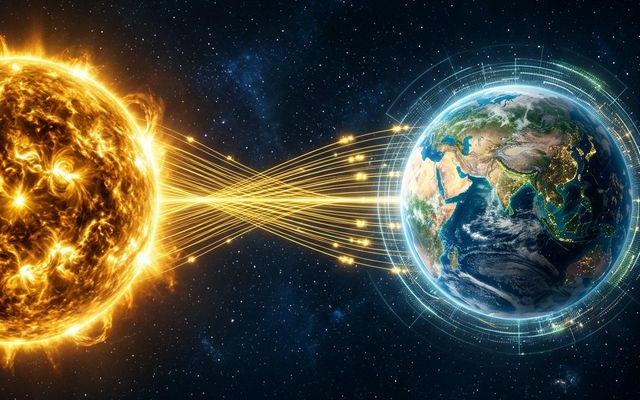
Now it is time to step outside. To look not at the source, but at what surrounds it. To see that this colossal flow we have been discussing does not vanish into the void, does not dissipate without a trace into the infinite cold of space. It has recipients.
Why This Matters
The Sun matters to us, to all living things, not because it is large. And not because it is hot in itself. Those would be merely astronomical characteristics. What matters is that its flow, its continuous radiation, subscribes the entire periphery to itself. All the planets. The whole Solar System.
In other words—and this is the key shift in perspective—the planets are not each hanging there on their own in abstract, empty, indifferent space. They exist within a regime. A regime set, dictated, and shaped by the central node. They are immersed in its field, its flow, its rhythms. And they are compelled, one way or another, to respond to that flow.
01—What “Subscription” Means in Nature
When we talk about a “subscription” in human applications, we imagine something voluntary. A button you can press—or choose not to press. A service you can cancel if it no longer suits you.
In nature, in the architecture we are considering here, “subscription” looks very different. It is not a button. It is the absence of choice.
If a system—any object, any planet—continuously, every second, for billions of years, receives an immense external flow of energy and signal, then it has exactly two strategies.
Either it somehow learns to receive that flow, use it, and integrate it into its internal processes. It finds a way not to burn up, not to break down, but instead to derive advantage from that influence. It evolves under it.
Or it exists in a state of constant degradation. It breaks down under the blows of that flow if the flow is too harsh for it. It remains in the shadows if it has screened itself off, yet still depends on indirect effects.
That may sound harsh, even cynical. But it is ordinary, perfectly normal engineering logic. If any device is powered by the electrical grid, it cannot afford the luxury of ignoring the grid’s parameters—voltage, frequency, current. Either it is designed for those parameters, works reliably, and uses the energy, or it breaks, burns out, and fails. There is no third option.
Armor / Important:
Subscription, in the natural, systemic sense, is a condition in which an external flow becomes such a basic, all-pervasive condition of existence that all the client’s internal processes—all the processes of the periphery—begin, in one way or another, to organize themselves around it. To accommodate it. In response to it. At that point, it is no longer a matter of choice. It is a matter of survival and function.
02—Earth as an Active Client
Most planets in our system, viewed from this angle, behave like passive clients. Like simple receivers. They receive the solar flow, heat up under its influence, and radiate the received energy back into space. That is all. Mars, for example, also receives the solar signal; it also has day and night, changing seasons. But Mars has no mechanism, no system capable of turning that incoming flow into complex internal work. No atmosphere capable of active circulation. No liquid ocean. No biosphere.
Earth can. And that is, when you think about it, an enormous difference. Earth resembles an active client not because we have proudly decided to call it one, but because of its complexity—because of the “software” it has on board.
What do I mean by “software”? Several interconnected, interacting layers:
- a dense, dynamic atmosphere,
- a vast liquid ocean covering most of the surface,
- active geology, continental drift, volcanism,
- and above all, the most complex layer of all—the biosphere, the totality of living things.
All these layers, all these systems taken together, work as a single mechanism. They receive the solar flow and convert it into complex internal work. Into atmospheric circulation, ocean currents, climate cycles, an endless chain of chemical transformations. Into life.
Armor / Important:
The Sun supplies the flow. It creates conditions, sets rhythms, provides energy.
Earth responds with internal processes. It receives that flow and, through the complexity of its structure, turns it into work.
And this coupling, this interaction, has been operating for so long that some processes have become literally hardwired into the planet’s mode of operation.
Photosynthesis is pure conversion. The transformation of the energy of light into the chemical energy of bonds. Biology learned to do that billions of years ago.
Circadian rhythms—the internal clocks of all living organisms, from bacteria to humans—are a strict synchronization with the daily cycle set by the Sun.
Climate cycles, the change of seasons, monsoons, trade winds—all of these are the global response of the atmosphere–ocean system to the uneven distribution of solar heat across the surface of a rotating planet.
Armor / Important:
This is client logic in its purest form. An active client does not create the flow it receives. It receives it. But it does not receive it passively, not like a dead stone, but through the complexity of its own structure. It interprets that flow. Processes it. And outputs the result of that interpretation—complex, ordered, living behavior.
03—“Synchronization” Is the Key Word
In the ordinary, familiar language of physics, we simply say: “The Sun heats the Earth.” And that seems sufficient. But in the architectural lens I am trying to unfold here, it is not only the heating that matters. Something else matters too—something deeper, more systemic.
The Sun synchronizes Earth’s regimes.
It functions as an external reference source, as the anchor relative to which the planet’s rotation on its axis and its motion along its orbit cease to be abstract geometry and become a living, working calendar. A frame of reference for every process.
The flow coming from the Sun does not merely feed the periphery with energy. It acts as a Global Clock. A global clock generator that sets the tempo for the entire system.
Look at how this appears across different timescales.
The alternation of day and night is the simplest tick. The signal appears, then disappears. The input-flow switch flips with a regularity you can rely on.
The change of seasons is already a more complex, slower cycle. A modulation of the signal caused by axial tilt and orbital motion. It sets the rhythm for everything that lives longer than a single day.
And long-term climate oscillations—cycles spanning thousands and millions of years—are cumulative effects. The result of how a system with enormous inertia responds to slow changes in input parameters.
04—Why Clients Do Not Respond “Instantly”
Armor / Important:
Each layer of the client, each subsystem of Earth, has its own inertia. Its own response speed. The atmosphere reacts to the change of day and night quickly. The ocean reacts slowly. Glaciers, slower still. The biosphere reacts in a complex, multi-layered way. But all of them, at different speeds and in different ways, synchronize with the same external source.
In bad, cheap science fiction, everything is simple and crude. The server “sneezes,” throws out an extra packet of energy, and the world at the periphery “immediately” reconfigures itself to the new signal. Instantly. As if by magic.
In reality, in a living, complex system, everything works differently. All clients, all subsystems, have what we call inertia. And that is not a bug, not a design weakness that ought to be fixed. On the contrary, it is the reason the system is stable. It is what prevents the whole thing from falling apart every time the central node sneezes.
Let us simply list the response speeds of Earth’s different “clients” when the input signal changes.
- The atmosphere responds relatively quickly. Wind, clouds, fronts—these changes can become visible within hours.
- The ocean is far slower. It is huge, massive, and excellent at retaining heat. It changes not by days, but by seasons, decades, centuries.
- The biosphere, all living things, responds differently again. It has no single speed. There is the adaptation of individual organisms, the migration of species, extinctions, and the emergence of new forms. These are all processes with different, often very long, evolutionary delays.
- Geology—continental drift, mountain building—operates on an entirely different, nonhuman timeline: millions and hundreds of millions of years.
So if I want to speak precisely, if I want this model to withstand criticism, then the formulation has to be this:
Armor / Important:
If the central node changes the parameters of its flow, then all connected clients—the entire periphery—find themselves in a situation where they are forced, one way or another, to adapt to those changes. But not instantly: they adapt within the limits of their own internal inertia, at their own speeds, and by their own means.
That seems to me a mature and honest statement. It removes the main objection any skeptic might raise: “But how can that be, if we do not see an instantaneous reaction to every burst of solar activity?” True. We do not. Not instantaneously. But that does not cancel the dependence itself. The inevitability of the response does not disappear. It is simply spread out over time, in accordance with the structure of each particular client.
05—Transition to the Next Scene
We have come a long way. We have seen the network: there is a central node that outputs a flow, and there are clients that receive that flow, interpret it, and build their complexity on its basis. The picture seems to be coming together.
But one delicate subject remains. A very important one—and an easy place to slip, giving any skeptic a fair reason to smile and say: “There it is again: poetry, metaphor, a substitution of concepts.”
I often use words like “signal,” “information,” “telemetry,” “data.” I speak of light as a channel that carries not only energy, but also information about the world. It sounds elegant. It fits the architecture.
But that raises a legitimate physical question. Is it actually correct, from the standpoint of rigorous science, to claim that “information” is a physical quantity like mass or energy? Or is it merely a metaphor I am stretching over reality, turning language into a beautiful but empty slogan?
Can “information” be weighed? Does it have an energy equivalent? Does processing it, transmitting it, storing it require real physical expenditure? Or is all of this merely a game of the mind?
This is not an idle question. It is central to the entire construction. Because if information is not physical—if it exists only in our consciousness—then the whole metaphor of “light as a data bus” remains merely a beautiful image. But if information has a physical price, if processing it costs energy just like any other process, then the architecture gains the support it has been missing. Then “signal” ceases to be a metaphor and becomes an operational characteristic of the system.
Armor / Important:
“Earth is not an autonomous system. The conditions for its processes come from outside. This is a client–server dependency.”
Next: Is information physical? Landauer’s principle and the cost of processing.