I have assembled the world’s basic “hardware” and “software.” The stage is set. The Sun supplies energy and sets the rhythm of processes. Gravity holds the geometry in place. Electromagnetism binds matter into dense forms. Everything works.
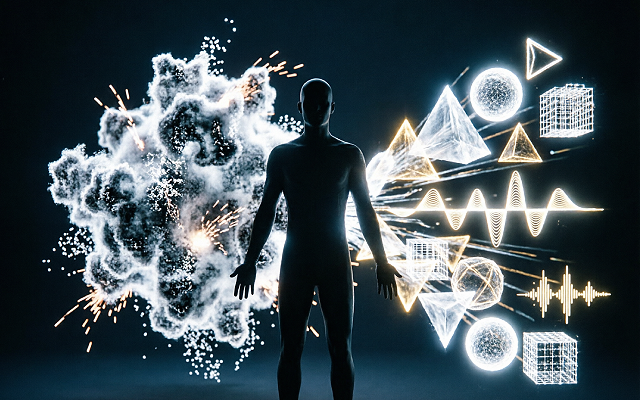
But an empty stage, even if perfectly configured, is still just a screensaver. Beautiful. Dead. For the system to truly come alive, something has to emerge within it—a process that can read this world, process it, and return it changed.
That is when the Agent steps onto the stage.
01—Safeguard
Armor / Important:
By calling a human an “Agent,” I am not trying to reduce our lives, emotions, love, and culture to a soulless block of code. This is a frame. A way of seeing. I use this architectural lens for one reason only: to show as clearly as possible how we interact with reality, where the boundaries of our systemic authority lie, and what our fundamental function in this world actually is.
02—Who Is the Agent Through This Lens?
In the traditional humanities perspective, a person tends to see themselves as the crown of creation—something special, the very reason everything was set in motion. In biology, the human being is the result of millions of years of random mutation and harsh selection, one branch among many on the evolutionary tree. But if we look through the systems lens I use throughout this book, a third perspective appears.
The Agent is one of the highest layers of assembly on planet Earth—an autonomous node that receives data, processes it, and sends the result back into the environment.
The layers beneath it are already running. Physics defines the foundational rules that hold everything together. Chemistry builds dense structures from them—molecules, tissues, everything you can touch with your hands. Biology sets self-reproducing cycles in motion, the very processes that keep the system from collapsing into dead dust. And the human being is a complex, self-learning process running on top of this colossal, multi-layered architecture.
The Agent enters the world with basic firmware inherited from millions of ancestors. It comes with built-in functions—breathing, swallowing, crying, fear. But it does not yet have a coherent picture of the world. So from the very first second, it begins greedily gathering data. Photons strike the retina and become images. Vibrations in the air enter the ears and take shape as sound. The skin registers resistance, warmth, and cold.
But the Agent is not a mirror. It does not simply reflect what it sees. It takes this raw, noisy, chaotic stream pouring in from every side and begins building an internal working model of the world. A model that makes prediction possible. It builds that model, tests it through trial and error, rebuilds it, refines it. And it does this for an entire lifetime, without stopping for a single second.
03—Why We Do Not Feel Physics
The defining feature of the human being is this: we are permanently locked inside our bodies, inside our user interface. We see only what the system shows us, not how it is built underneath.
Try to imagine what happens when you bring a mug of hot tea to your mouth. You feel warmth. You feel the liquid burning your tongue. But you do not feel water molecules vibrating faster because of heat. You do not feel electrons in the outer shells of atoms repelling your receptors. All that reaches you is a finished, assembled, packaged signal: “hot.”
We do not perceive the world at the level of its deep physics. We perceive it in a form suited for life and action. It is like the icons on a computer desktop—behind them lies a complex program, but you just click the symbol.
We do not need to know how atoms and fields work just to walk down the street without falling. Something—call it the engine of reality—has hidden all that complexity from us. What remains are readable signals: solid, liquid, hot, cold, far, near. That is enough to survive, to act, and to understand what is happening around us.
We are free to learn. To change our habits, master new things, and rewrite our own internal software. We are free to reshape the world around us—to build cities, lay roads, create technologies. But we do not have access to the source code of the universe. We cannot cancel gravity. We cannot stop aging. We cannot rewrite the laws of physics to suit ourselves, no matter how much we may want to.
We are users—with broad permissions, but limited ones all the same.
04—What the Agent Is For
If the Sun is the main node flooding the world with energy, then what does the Agent do? What role does it play in this system?
The Agent does work. It takes the raw, chaotic stream of what happens to it and turns it into something meaningful. It compresses chaos into order.
A chaotic set of sounds becomes music. A piece of stone or wood becomes a tool. The noise of a crowd—shouting and argument—becomes a rule, then a law people begin to follow. A random event, a lightning strike, becomes science, which explains how it works.
Every action of the Agent leaves a trace. Sometimes we turn chaos into order. Sometimes, on the contrary, we add new noise to the world. But either way, the world after us is no longer the same as it was before us. The system remembers these changes. It records them.
We are constantly rewriting what surrounds us, leaving structural traces behind.
05—Why We Cannot Work Without Stopping
So, we have the Server, which supplies the world with energy. And we have the Agent, which learns, acts, and turns chaos into order on this stage.
But the Agent cannot run without interruption. Its body and brain require regular maintenance. If the system is never allowed to rest, it overheats, begins to fail, and loses the ability to process the incoming stream.
The organism has to recover regularly, process accumulated experience, and relieve the overload.
That is why the system of life inevitably switches us between two modes.
Next: How exactly does the Agent maintain its own system? Why do we spend a third of life in an offline state, and what is really happening in the brain when the lights go out? Next, we examine the systems architecture of Sleep and Wakefulness.