In the previous installment, I allowed myself the image of “the Sun as the Main Computational Node.” I offered that lens as a working tool. Now we come to the most important part. The most interesting part. The stress test.
Guardrail (Armor)
Armor / Important:
Everything below is strictly an engineering lens—a way of looking.
I take the real, observable, measurable properties of our star—things any schoolchild knows, and that thousands of scientific experiments have confirmed. And I ask only one very simple question: what specific role, what function, do these properties play at the scale of our entire local system—the “Sun—Earth—Life” system?
If the role reads clearly, and if it explains the connectedness and integrity of that system, then the model is useful. It can be used as a working tool. If the role does not read clearly, if the explanation has to be forced, then the model goes in the trash. No regrets.
I claimed that any central interface in a complex architecture has to perform four basic roles. Let’s now take them one by one, as elements of a living, working system.
01—Role 1. State Retention (The Node That Ensures Structural Stability)
In the architecture of any complex computational system—in any serious project—there is the idea of maintaining state. State. Stability. Usually, when people talk about state preservation, they imagine writing data to a hard drive or a database. But in a deeper, more fundamental sense, state retention is everything that gives a system inertia. Everything that gives it stability. Everything that keeps the structure from falling apart at the first external disturbance, the first shove.
In that context, within our local system, the most “boring,” most obvious characteristic of the Sun—its enormous mass—becomes the strongest and most decisive structural argument.
The solar node is not just a heavy object. It is, let me remind you, almost all the mass in the system. More than 99.8 percent of all its matter is concentrated in one place. And it is precisely this—this monstrous gravitational well—that makes it the component performing several critical retention functions at once.
It locks in the orbital structure of the entire periphery. All those planets, asteroids, and comets do not fly wherever they please; they are forced to circle it along strictly defined trajectories, because it sets the rules.
It defines the large-scale geometry of the surrounding space. It curves that space with its mass so that ideas like “up” and “down,” “closer” and “farther,” acquire a clear and stable meaning.
And it creates that stable “frame,” that invisible but rigid structure within which all other, subtler and more complex processes become possible. Stable, repeatable cycles—years, seasons, ages—exist only because that frame is there, preventing everything from flying apart.
In the language of systems engineering, this is the function of baseline stability. The Sun operates as a gravitational reservoir, as a flywheel that physically—by virtue of its mass alone—holds our entire local cluster together in an assembled, working state. Without that reservoir, there would be no system. There would only be diffuse gas dispersing into the void.
Armor / Important:
Engineering Translation:
Mass → gravitational framework → state retention.
Without that framework, “peripherals” like our Earth would simply stop being peripherals. Matter would scatter in different directions, no stable regimes could repeat year after year, age after age, and any complex chemical assembly—any molecule aspiring to life—would not even have a fixed reference point, a stable place in space.
One thing matters here. This is literally, physically what gravity does. I am not inventing anything. I am only changing the angle of view. Instead of asking, “How does gravity work?” I ask, “What function does it perform at the scale of the system?” And the answer turns out to be simple and brutal: it performs the function of preserving structural continuity. The function of a frame.
02—Role 2. Cycles and Timing (What Sets the Periphery’s Rhythm)
The second thing we expect from a central node in any architecture is the ability to set a rhythm. Any processor, any controller, is built on the simplest possible principle: timing and repeatability. Even if deep inside—at the level of micro-operations—there is complex, tangled chaos, the system must still present a clear, predictable rhythmic signal at its interfaces. Otherwise, no complex peripheral layer can synchronize with it. Nothing can function properly.
The Sun, viewed from this angle, operates in a remarkably clear and stable mode. It provides a steady external marker—the metronome against which cycles on completely different timescales are organized.
We can observe:
- rapid, near-instant pulsations of plasma and magnetic structures on its surface;
- the daily rhythm, the alternation of day and night, which becomes the main anchor for all biology against the backdrop of Earth’s rotation;
- seasonality, the cycle of the seasons, which arises from orbital geometry but depends on the constancy of the source;
- multi-year cycles of solar activity, with their eleven-year periods, which also affect everything from climate to human well-being.
The mechanics matter here. Yes, day and night, and the change of seasons, depend on Earth—on its rotation and the tilt of its axis. But the primary source, the signal that makes those cycles meaningful, is the powerful, stable reactor at the center. It sets the basic rules of the game. It serves as a natural Global Clock, a global timer, for a vast number of local processes unfolding at the periphery.
And life—all biology—uses this rhythm not metaphorically, not as a pretty image, but literally. In the most direct sense. Living organisms are programmed, optimized, for this repeatability. For the alternation of day and night. For the change of seasons. Living algorithms love predictability because predictability allows them to conserve the most important resource—free energy. And complexity, as we know, always grows where synchronization makes economy possible.
Armor / Important:
Engineering Translation:
A continuous, stable energy source plus a predictable, repeating geometry of relative positions between nodes (Earth rotating on its axis and orbiting the Sun) → the clock rate and calendar of the entire system.
That system pulse, that rhythm, creates determinism: by relying on the external, absolutely dependable rhythms of the central node, living systems can plan behavior and allocate resources in time. They can, ultimately, simply know when to sleep and when to hunt.
03—Role 3. Transmission Channel (Energy as Flow and Light as Telemetry)
And here, once we start talking about a transmission channel, the phrase “central interface” stops sounding like a stretch and starts sounding like the most natural description possible. In real hardware systems, in real engineering, it is not unusual for a single physical channel to perform two functions at once. In some networking technologies, for example, power and data travel through the same cable. That is considered an elegant, efficient solution.
Solar radiation—the solar beam—is exactly that kind of combined channel.
On the one hand, it is a power line. It carries energy. It creates on Earth the thermal and pressure gradients that make all work possible. Wind, ocean currents, photosynthesis—everything.
On the other hand, it is an information bus. The photon stream makes the entire scene optically observable. It allows us—and not only us, but any optical system—to see the world.
I am deliberately avoiding mystical language here. I am not saying that the Sun “turns matter into information”—that would sound nice, but it would be false. Physics is simpler and harsher than that.
The node generates a powerful, stable stream of photons. And that stream becomes a data-bearing signal not by itself, but only because it interacts with matter. It strikes objects, reflects off them, gets absorbed in specific spectral bands, scatters. It “reads” their properties—their shape, texture, chemical composition. The peripheral world “answers” the light.
Look at how this works.
- Eyes—biological sensors—or cameras can register the surface of an object only because that surface redirects the incoming beam, sending back a pattern of its properties.
- We can distinguish the chemical composition of materials because each material has a unique spectral response, its own signature in reflected light.
- The atmosphere filters and modulates that signal along the way, acting like a complex optical router, letting some frequencies through and holding others back.
Armor / Important:
Light is the hardware ping of the scene.
Every photon that reaches Earth is a query to reality. The scene receives that query and answers it—it reflects part of the spectrum, absorbs another—and through that answer becomes measurable, visible, knowable. At the same time, that very same beam, those very same photons, power the climate, drive the winds, evaporate water, and sustain the entire biosphere. One channel—two critical functions. Power and telemetry.
Engineering Translation:
Light emitted by the Sun functions as a Data Bus and a Power Line combined in one physical medium. This is a classic—if unbelievably large-scale—engineering solution.
04—Role 4. Boundary and Protection (The Shell of Influence)
The fourth role we expect from a central node in any complex system is the creation of a boundary. A protective contour that separates an ordered internal environment from external chaos.
Here we need to be especially careful with wording so we do not slide into science fiction. I am not going to claim that our system is protected by some perfect “magic shield,” like in a bad movie. That would be factually wrong. A stricter, more accurate term for the role I see here is a basic Firewall.
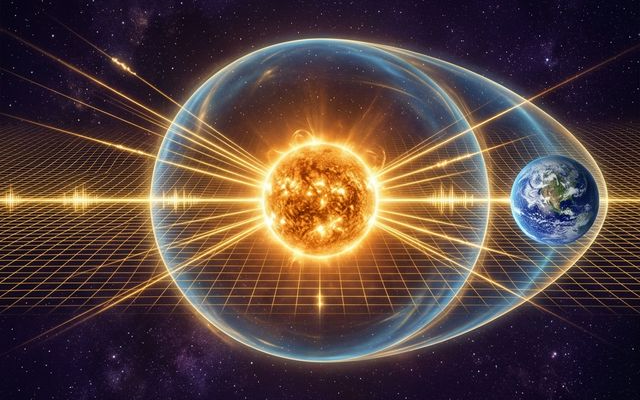
What is actually happening? The central node—our Sun—is not just hanging passively in space. It is constantly, actively blowing out an enormous bubble: the heliosphere. This region extends far beyond the planetary orbits and is filled with solar wind and magnetic fields. It is not a monolithic, impenetrable wall—that would be too simple. But it does function as a dynamic buffer, a border zone that filters and softens external impact.
What does that look like in functional terms?
The heliosphere physically slows and partly deflects the flow of aggressive interstellar radiation—galactic cosmic rays. Some of that radiation simply cannot get through with the same force.
It distorts and modulates the trajectories of extremely high-energy particles arriving from deep space. It alters them. Weakens them.
And most importantly, inside the heliopause—that boundary where the solar wind collides with the interstellar medium—physical conditions differ noticeably from what is happening in the “open” space beyond it. Inside, we have our own local environment, with its own parameters.
The analogy with a Firewall is appropriate here not because I want to anthropomorphize the Sun or assign intentions to it. Not because it “wants to protect us.” Only in a functional sense. Only because of the effect it creates.
Armor / Important:
Engineering Translation:
The shell of influence created by the node (the heliosphere) functions as a filter for external hardware noise. It screens out the harshest interference, increasing the stability of the runtime for all local objects, including Earth.
This is about architectural effect. About how the system is built. Not about the intentions of a star that, most likely, does not care about us at all.
05—Mini-Assembly: Why This Is Architecture, Not Metaphor
If, after all this analysis, we compactly assemble those four roles into a single picture, what emerges is something any developer, any engineer, will find painfully familiar. This is the classic profile of a core node in any complex system.
- State Holder (Mass)—Enormous mass creates the physical framework and keeps the entire cluster from inevitable disintegration. A gravitational reservoir.
- Clock (Rhythm)—Stable foundational cycles synchronize all peripheral algorithms, from climate to biology.
- Data Bus (Light)—A combined channel for energy transport and optical readout of the world’s state. Power and telemetry in a single stream.
- Firewall (Heliosphere)—A dynamic shell of influence that filters destructive external noise, maintaining acceptable conditions for all computation—for stable runtime.
I want to stress one important fact here. The astrophysical object called the Sun, this G2V-class star, does not need to be a processor in the literal silicon sense in order to perform all these functions. It does not need to think, feel, or have a goal.
But because this object really does perform them—totally, across billions of years, with extraordinary consistency and without failure—calling it the “supporting interface” of our local system, and its “engine,” stops being poetry. It becomes an almost strict, almost technical description of the functional dependencies within which all of us exist.
Armor / Important:
If the language of systems architecture allows us to identify parallels this clear and this internally consistent, if it gives us a single lens through which mass, light, cyclicity, and magnetic enclosure resolve into one coherent picture—then this is a powerful concept. It is a tool worth taking further. Worth carrying into the next installments, into the next questions. If this construction could not be projected onto observable facts, if it fell apart at the first touch, it would remain the one thing I most did not want it to be—a cheap esoteric trick. But it did not fall apart.
06—Where This Leads Next
In this installment, I have assembled what you could call the “hardware” part of the picture. The bare-metal part. Step by step, I tried to show why the Sun can be treated as a central system component without coming into conflict with a single physics textbook. Mass as framework. Cycles as timing. Light as a combined power-and-data channel. The heliosphere as a protective screen. Four roles, four functions—and all of them performed by a real, observable object.
But one final question remains. A question that has probably been sitting in your mind for a while already. And it is a perfectly fair one.
Why use all this heavy terminology—“server,” “processor,” “node,” “interface”—if simpler, drier words would do? If we can just say, “The Sun is an energy source,” and leave it at that?
Why use these metaphors if they add nothing to physics?
The answer, it seems to me, lies in one important detail. In any system, a computational node is not merely a supplier of energy. A battery is also an energy source, but nobody calls a battery a processor. A computational node is something more. It is structure. It is organization. It is the ability to provide coherence across processes. It is the creation of that very environment—that very runtime environment—within which complex, coordinated, thinking structures can arise and exist at all.
And that side of the picture—organization, coherence, the assembly of reality—is exactly what we have barely discussed so far. We have been talking about hardware. Now it is time to talk about the software running on that hardware.
In the next installment, I will begin a detailed expansion of how that code is actually executed. We will talk about the periphery. About how Earth’s dead matter and living biology act as the Client—receiving that hardware ping, reading the clock signal, and unfolding on the basis of that signal what we call our life and our consciousness.