There comes a point in any serious conversation, in any concept that tries to take in a little more than the habitual view. A point after which everything either becomes a working tool, a useful lens through which to see the world, or quietly slips into a fairy tale. Into a beautiful but useless fantasy. That point is the boundary between observation and fiction. And I very much do not want to write a fairy tale. What interests me is something else: trying to hold that edge. So now it is necessary to do what any sane engineering task begins with: set the frame correctly and firmly. Define the rules of the game we do not step beyond.
Guardrail (Armor)
Armor / Important:
Before we move on to the functions, let’s fix one thing again: I am not abolishing physics textbooks, and I am not writing a new religion. I am simply applying the engineering method of the “black box” to an astrophysical object. That’s all.
01—A Shift in Perspective: Interface Instead of Object
In the familiar, well-worn paradigm we grew up in and rarely question, the Sun is an astrophysical object. A blazing sphere of plasma, a hydrogen-helium mix, magnetic fields, thermonuclear reactions in the core, neutrinos, spots, flares. And all of that is plain, indisputable truth. There is no point arguing with it.
But let’s try, just for a moment, to shift the focus. Not to deny that truth, but simply to move the lens. To apply to the Sun the method used to analyze any complex system when we do not know its internal structure. The method known as black-box analysis.
What does an engineer do when they have no access to the source code, the circuitry, the blueprints? They do not pry it open with a screwdriver. They look at the system’s external behavior. They analyze what goes into the box and what comes out of it. They study its operating modes, cycles, rhythms, and signals. And from that observation they draw a conclusion: what function, what role this node performs in the overall architecture. Not “what is it made of,” but “what does it do.”
And if we look at the Sun from exactly that point of view—from the viewpoint of an engineer studying a black box—it turns out to be an ideal, near-flawless candidate for the role of a central supporting component. Let’s simply list what we observe every second.
It provides the most powerful, most stable informational signal in our local universe—light.
It guarantees the basic, uninterrupted flow of energy without which all living things would collapse almost instantly into nothingness—radiation.
It holds the main spatial framework together, defines the coordinate system, prevents everything from flying apart—the gravitational center.
It forms around itself a vast zone of influence, a protective shell extending far beyond the visible planets—the heliosphere and magnetic structures.
These are the four parameters. We register them every day, every second. Quite literally with our eyes and skin, by the mere fact of our existence. This is the “indicator panel,” the dashboard that, even without access to the source code, without formulas and telescopes, reveals the functional role of this node. The role of the center.
02—Main Computing Node
To keep this whole construction from dissolving into abstraction, to arrive at a practical working language, I suggest taking one more step. Reduce everything to a single engineering image. Not to replace physics with it, not to claim that this is what reality “really is,” but simply to make the concept more graspable, more usable, easier to wear against reality.
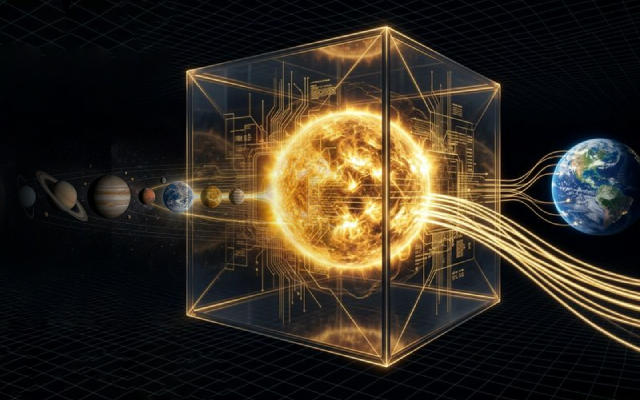
Within this philosophical-engineering model, it is both logical and useful to view the Sun as the Main Computing Node of our planetary system.
It matters here to agree on terms right away. When I say “Main Computing Node,” I do not mean a metal box with fans. I mean the role being performed. The function this node takes on.
What does that mean in terms of system architecture? The solar node:
- Creates gradients. Stable differences in temperature and pressure. In physics, a gradient is the number-one condition for any work to be done. The Sun creates that difference, and the world begins to move, flow, live.
- Sets cycles. Daily, seasonal, annual. This is the basic clock rate, the rhythm by which everything synchronizes—from plant blooming to bird migration to our own sleep.
- Feeds complexity. It provides a colossal resource—free energy—that allows non-equilibrium structures to persist within the system. It allows them to resist entropy, the inevitable slide into chaos.
- Forms a communication channel. Its radiation is not just energy transfer. It is also a signal linking center and periphery, making the scene observable and interaction possible.
Put simply: this is the central node that keeps our entire system in a coherent, working state. Without it, the system does not merely “switch off.” It becomes a heap of dead, cold, disconnected matter scattering into the void.
03—Why We Look Only at Our System
This is an important point, and it needs to be made immediately. I say “local” for a reason. The scale of this thought experiment is strictly limited. This is our specific computing cluster: Sun—Earth—life—observation.
I am not trying to scale this model up to the whole infinite universe and go looking for some Absolute Center. My task is more modest and more concrete.
I am focused on one question: why, within our local scene, is there such an obvious, dominant node? A node whose hypothetical removal would lead to the immediate collapse of all observable reality. Within those limits, the model is freed from any claim to being a cosmic religion and becomes what it was meant to be from the start—a useful descriptive tool. A lens through which you can notice what used to slip away.
04—How Energy Becomes Signal
One more clarification is necessary here, so we do not slide into empty mysticism. It is very easy to say something like: “The Sun turns matter into information.” It sounds impressive, but that is esotericism.
Let’s trace the physical chain:
- In the core of the node, energy is released.
- That energy is transmitted outward as radiation.
- That radiation itself—light—interacts with objects and acts as a basic carrier of data. It carries information about shape, texture, temperature, and motion.
So the system’s core isn’t running on magic. It generates a flow through which the world becomes observable, measurable, and synchronized. Light is both energy and signal at once. This fusion of critical functions in a single channel is a textbook pattern of a central control interface.
05—Four Roles of the Node for Further Analysis
To turn this model into an applied tool, it helps to single out its “structural frame”—four basic roles characteristic of complex computational architectures:
- Memory / Stability. Mechanisms that preserve the system’s parameters and ensure its long-term stability.
- Cycles / Clocking. Regular operating modes that synchronize processes at the periphery.
- Transmission Channel. The streaming link between the center and the terminals (energy + information).
- Protection / Boundary. A shell that cuts off external chaos and creates a protected zone inside.
This is a working hypothesis. If the Sun really does play the role of the main node in our system, then its functionality should map clearly onto these four roles. Let’s test that.
06—Conclusion of the Series: Tool, Not Dogma
Any mental model is useful only insofar as it makes the world clearer without coming into conflict with basic physics.
If a shift in perspective adds clarity, I will use it as a working language. If at some point the model starts producing nothing but fog, I will discard it.
So what comes next is not a call to “believe.” It is a calm engineering assembly. Next we will take these four roles and examine them one by one. Step by step.