In the Sun’s core, reactions take place every second that keep the star alive. For that to happen, hydrogen nuclei—protons, each carrying a positive charge—have to get close enough for the nuclear force to “grab” them. But there is a problem. Like charges repel. And they repel strongly, long before the particles reach the distance at which the needed interaction switches on. Classical physics says that at the temperatures found in the solar core, the probability of such a close approach is negligible. The reactions should barely smolder. But they do happen. Steadily, powerfully, for billions of years. Why?
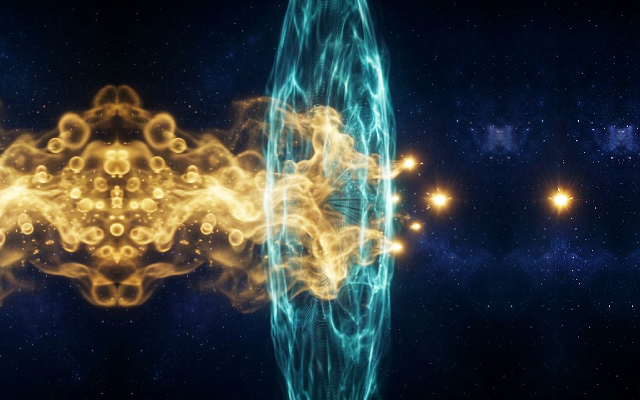
Not a Breach, but Permission
In the world we are used to living in, things seem simple. If there is a wall in front of you, then either you can break through it—if you have enough force—or you cannot. There is no third option.
In the quantum world, a wall is a different kind of thing. It is not like brickwork that simply either exists or does not. It is more like a region where the probability of getting through drops sharply. But it does not drop to zero. Almost to zero—but not to an absolute, mathematical zero.
And from that comes a mechanism we should talk about carefully, without unnecessary drama.
Armor / Important:
Quantum physics allows for a particle to have a nonzero probability of being found on the far side of a barrier. Not a guarantee, not a command—just a probability. And sometimes that is enough for the event to happen.
That is what tunneling is. Not “passing through a wall” in the way we imagine a ghost passing through bricks. It is better understood as “not completely forbidden.” There is a tiny but nonzero chance, and nature makes use of it.
Armor / Important:
This is not a “cheat” or a bug in the design of the world. It is a normal, honest consequence of how reality is structured at the deepest level. And in the case of the Sun, this mechanism turns out to be critically important. Without it, fusion reactions at the temperatures present in the core simply would not happen. And neither would we.
01—What the “Barrier” Is, and Why It Seems Impassable
Put as simply as possible, without formulas: every hydrogen nucleus—every proton—has a positive charge. And charges of the same sign repel each other. The closer they try to get, the more strongly they are pushed apart.
For fusion to occur, they have to come close enough for another force to take over—the nuclear force, which begins to attract them and hold them together. But there is a catch. That force only “switches on” at extremely short distances, much smaller than the distances at which the electrical repulsion is still working furiously.
So the picture looks like this.
At intermediate distances, repulsion dominates. The closer the protons get, the stronger it becomes, and the harder it is for them to meet.
At very short distances, repulsion gives way to attraction—if the particles somehow manage to get that close.
But that intermediate stretch, that “bridge” from one regime to the other, looks almost impossible to cross.
Common sense, trained on the large-scale world, says that an enormous amount of energy would be needed to force a way through that repulsion. And there is indeed a lot of energy in the Sun’s core. The temperature there is about 15 million degrees. The particles are moving at tremendous speeds.
But even that temperature, if you calculate things by the rules of classical physics, is not enough. It falls short. The reactions should be barely sputtering along, and yet what we observe is something entirely different.
Armor / Important:
Without quantum mechanics, you get a strange result: a system producing such a powerful, stable output should, by all classical estimates, be producing almost nothing. An engineering contradiction.
02—Tunneling as a “Probabilistic Pass”
Now let’s try to describe the same thing in a different language. Not by replacing physics, but simply by looking at it from another angle.
I am not going to say that nature “hacks its own rules” or flips some secret switch. That would be false. Quantum mechanics does not bypass the laws—it is the law. It is just that the law is more subtle and more complex than we are used to imagining.
So if we are choosing our words carefully, it is better to put it like this:
Armor / Important:
Tunneling is a mechanism that does not forbid a transition completely, but leaves a loophole for it. A probabilistic pass.
It does not guarantee that a particle will get through. It says something else: the particle can get through, with some probability. Sometimes once in a billion attempts. Sometimes more often.
In the language of any complex system, it looks something like this. There is a transition between two states. It is not sealed shut, not bricked over. There is no sign saying “No Entry.” There is a sign saying “Passage possible, but not guaranteed.” And that changes everything.
Armor / Important:
Not “the safe was picked with a lockpick.”
“The safe does not have an absolute lockout. There is a chance the lock will click, and sometimes it really does.”
So far, that may still sound abstract. But then simple arithmetic enters the picture. In the Sun’s core, there are not merely many such “attempts to get through.” There are inconceivably, astronomically many. Every second, countless protons collide and try to get close enough.
When the number of attempts reaches billions upon billions, even events with a one-in-a-trillion probability stop being rare. They become routine. They become a regular occurrence.
The temperature in the core determines how many particles can get close enough to try at all. Tunneling is the chance that a given attempt will succeed. Two factors, two numbers, working together. And the result is what we actually see: a stable stream of reactions lasting for billions of years.
Armor / Important:
For a single particle, getting through the barrier is almost a miracle. For a system containing an inconceivable number of particles, that miracle becomes an operating mode. The very one on which everything depends.
03—The “Tail” of Something You Cannot Touch
To keep things from becoming too complicated, let’s look at the difference between classical and quantum physics through one simple image.
In the world we are used to, a particle is like a billiard ball. If it rolls into a solid wall and does not have enough energy to get over it, it simply bounces back. There are no other options. A wall is a wall.
But in the quantum world, a particle is not a hard little ball. It is more like a trembling “cloud of probability,” or a signal. And when that signal meets an apparently impenetrable barrier, it does not stop abruptly like a wire that has been cut. It starts to fade rapidly inside the barrier itself.
Most of the signal is reflected, but its tiny edge—like dense fog creeping under a closed door—seeps through the obstacle.
If the barrier is not too thick, that faint “tail” of fog can make it out the other side. And then there is a precisely calculable chance that the system will register the particle as being there already—beyond the wall.
Armor / Important:
The object does not “punch” a hole through the barrier by brute force.
Its signal leaks slightly through the obstacle. And sometimes that faint, fading trace is enough for the system to “render” the particle on the other side.
That wording, I think, is enough. It stays within the bounds of physics, but it also gives us the language we are looking for: a language with no crude “cheats,” yet one that still allows for a subtle access mechanism built into the system.
04—Why This Strengthens the Model
We need to be careful here not to make the wrong move.
I am not saying, “Tunneling proves that we live in a simulation.” That would be both cheap and wrong. Physics remains physics, and it explains tunneling perfectly well without invoking simulations.
I am saying something else: that this phenomenon fits remarkably well into the language I am building here.
Armor / Important:
Tunneling shows us that reality can organize transitions from one state to another not only in the crude way—“push harder and break through.” It can do it differently: through probability, through permission, through a subtle mechanism in which the prohibition is not absolute.
And that aligns strikingly well with how we describe complex systems.
- There are rules that determine what is allowed and what is not.
- There are conditions under which probability rises or falls.
- There are statistics that turn a rare event into a regular one when the number of attempts is enormous.
- And out of all that, a stable working regime emerges.
If you think about it, the world turns out to be no less strict than we thought. It is simply strict in a different way. Its rigor does not always fit inside the mechanical, visual imagination we are used to relying on.
And it is important to make one honest admission here. The fact that physics can be described in the language of protocols, gates, and probabilistic permissions does not mean that it is a computer or a simulation. It means something else: that this descriptive language works. It lets us see connections that were previously easy to miss. And as long as it works, we are entitled to use it as a tool.
And one final point, for the skeptic who has been watching every word.
Armor / Important:
Quantum mechanics does not abolish the laws of nature. It changes the form of prediction. Instead of a single clear trajectory, we get a distribution of probabilities. Instead of a guaranteed “yes” or “no,” we get a chance. And that turns out to be enough for the world to work.
05—The Link to “Compilation” in the Core
Now I can close the loop:
Armor / Important:
Hydrogen—input.
Fusion—processing.
Energy—signal.
But without a permission mechanism, fusion would not be a stable operating mode under real physical conditions.
Armor / Important:
Tunneling is one of the internal “gates” that makes the pipeline not merely possible in principle, but actually operational.
In other words, tunneling functions here as a channel of permission. Without it, the “request” for fusion would almost always run into the barrier—the protons simply do not have enough energy to overcome it classically. With it, a nonzero throughput appears, and the pipeline really does produce an output.
06—Transition to the Next Scene
So we have worked out how this “rule of access” operates. How particles manage to do what seems impossible. But that brings us to the next question. And now the question is no longer about individual events, but about where all of this happens.
What, in this scheme, sustains the process itself? Where exactly does it “live”?
What conditions, what parameters, what rules have to come together for this process to last not for a second, not for a minute, but for billions of years?
We need that question if we are finally going to stop looking at a stellar core as just a “very hot furnace” where something smolders. We need to start seeing it differently: as an environment. As a space in which everything is tuned so that the process does not stop.
Armor / Important:
“What looks like a miracle for a single particle becomes a regime for the system.”
Next: The environment in which the process lives. The Sun’s core as a stable regime: why it is not just a “furnace,” but something more.