We have been looking at the Sun since childhood. From the very first day, from the first glimmer of consciousness, it is already there—a yellow spot in the sky that you cannot look at head-on, yet without which the world is impossible to imagine. We grow so used to it, so deeply used to it, that it stops feeling astonishing. It becomes just a free lamp in the sky, working without interruption: it rises, it shines, it sets. And so it goes every day. Thousands of years. Millions.
In summer, we resent it—too fierce, too hot; we hide in the shade, we look for air conditioning. In winter, by contrast, we welcome every ray, catching it on our faces as if it were a rare gift. In spring, we search for it with our eyes when it suddenly vanishes behind heavy clouds for a whole week, and without it everything feels gray, flat, unreal. We open windows to meet the light, set out flowers on the windowsills. We hang our plans on it without even noticing: “I’ll go out when it gets light,” “I’ll travel when it gets warmer,” “I’ll begin when the sun comes up.”
And almost never—I mean truly, directly—do we ask ourselves one question. A simple, childlike, almost naive question. But exactly the kind that can put a faint, barely visible crack in any familiar, settled picture of the world.
Why is this particular source of light, this one star in the infinite cosmos, so important to everything that is possible here at all?
Of course, you can brush it off. You can say, “because it gives heat.” That is the shortest, most obvious answer. But if you think about it, it is too short. It sounds as though we are talking about a simple battery in a TV remote: there is power—there is a picture; the battery dies—the remote stops working. Simple enough. But in reality, if you look closely, the dependence of all living things on the Sun turns out to be far deeper, far stranger, and far more fundamental than a device’s dependence on an outlet.
The Sun does not merely add convenience to our lives. It does not merely make life more pleasant or warmer. It sets, shapes, dictates the very possibility of the game. The possibility of complex structures existing at all. The possibility of what we call life.
So let us try to take one step without mysticism. Without poetry. Let us simply look at our lives, and at the lives of all living things, as a set of conditions. In any complex structure—whether a computer, an ecosystem, or an economy—there are basic, foundational parameters. The ones without which everything else loses meaning. The temperature range in which chemical reactions are possible. The rhythms by which processes synchronize. The gradients that create motion. The available energy that allows the complex to be built out of the simple. The signal that makes orientation possible, that allows navigation through space and time.
And if those basic parameters suddenly vanish, the environment does not merely become “less pleasant” or “a bit colder.” It stops being the ordered reality we know. It goes dark. It turns into something else—dead, static, unfit for life. And the Sun, from any angle, stands at the center of every one of those parameters.
01—A Derivative of the Sun
And here, if you allow yourself to follow that thought all the way through, a rather unpleasant, almost frightening clarity appears. It turns out that for Earth—for everything on it that exists, breathes, moves, thinks—almost everything we are used to calling the “natural environment” is in fact a derivative of the Sun. A first-order derivative. Everything we see, feel, and take for granted is only a consequence, only a shadow cast by a single source.
- Night. We think of it as the time “when it gets dark,” when we can sleep. But within this mechanism, night is not simply the absence of light. It is a change in the operating mode of the entire scene. A mode in which the world loses most of its visibility, drops into low resolution, switches to backup power.
- Day. It is not just “bright outside,” so there is no need to turn on a lamp. It is the mode of full observability. The mode in which the scene is open, all objects are visible, and energy arrives without restriction. The system’s working hours.
- The seasons. We poetically call them “nature’s moods”; we grow melancholy in autumn and rejoice in spring. But strip away the romance, and they are simply macro-cycles. Global, programmed shifts in the modes of energy supply. The system opens the valve, then tightens it, and depending on that, everything changes—from the color of leaves to the behavior of animals.
- Weather. A whim, a quirk, a topic of small talk with the neighbors. In reality—a massive, extraordinarily complex computation that the planetary computer runs continuously, relying on atmospheric temperature gradients created by that same Sun.
And let us go further. Even what we reverently call “living nature”—forests, oceans, bacteria, ourselves—is, if viewed through the cold eye of an engineer, nothing more than a hyper-complex algorithm. An algorithm that somehow manages to hold itself back from inevitable degradation, from entropy. And it holds only because of one thing—a powerful, continuous, colossal incoming stream of energy. Shut off that stream, and the whole structure collapses in an instant.
02—Guardrail (Armor)
Before going any further, I want to put one important logical circuit breaker in place. So that later we do not argue about things that are pointless to argue about.
Important: I am not going to argue with physics. Physics is right. I am not going to “prove magic” or claim that any of this works differently from what textbooks describe. I am proposing something else. A thought experiment. The construction of an architectural model. It does not cancel out the school textbook, does not cross out thermodynamics, does not forbid Maxwell’s equations. It simply answers a completely different kind of question. Not the question “how is this mechanically arranged, out of what particles and fields,” but the question “what role does this play in the overall order of things, why is it needed, what function does this element serve.”
At the level of “how it works,” we are in good shape. We have a strong, coherent, experimentally confirmed picture. The Sun is a G2V star. Thermonuclear reactions take place in its core; hydrogen turns into helium; energy is born in the depths, spends millions of years forcing its way outward through layer after layer, and then travels to Earth at the speed of light in the form of electromagnetic radiation. All of that is correct. All of that is verified.
But look at what happens if, instead of the usual “how does it work,” we suddenly ask a different, displaced question. A question physics usually does not ask, because it lies on a different plane.
Why does a single interface node, one star in the infinite cosmos, exert such total, absolute influence over all the fundamental properties of our local scene?
Why has light—this stream of photons—become such a basic, primary channel for our reality? Why are biology, climate, our internal clocks, our hormones, our rhythms of sleep and wakefulness, and in the end all of human civilization with its cities and factories, tied so rigidly, so hopelessly, to a single source? Physics has an answer about energy. But does it have an answer about meaning?
03—The Scale of Dependence
So that this does not sound abstract, so that the conversation does not hang in empty air full of beautiful but hollow generalities, let us simply list a few dry, almost engineering-level facts. I am not using them to create a false aura of scientific seriousness, but for one reason only: to let us truly, viscerally feel the scale of the dependence we live inside. A dependence we have stopped noticing, the way a fish stops noticing water.
The first fact is about time. Light takes a little more than eight minutes to travel from the Sun to Earth. A little over eight minutes—and a photon born in thermonuclear hell touches your retina. That means our entire “daytime interface”—everything we see, every shadow, every color, vision itself as a process—rests on a signal that connects us to its source almost instantly. By cosmic standards, that is hardly a distance at all; it is direct line of sight.
The second fact is about energy. Almost all the energy available to the biosphere, to climate, to the movement of air and water masses, is solar in origin. Almost everything. Even when it seems to us that it is the wind doing the work, or a river spinning a turbine, or coal burning in a furnace—if you dig all the way down to the root, the Sun is still there. It creates the very differences in temperature and pressure that set the atmosphere in motion. It evaporates the water that later falls as rain and fills the rivers. Even coal and oil are nothing but stored solar energy, accumulated by ancient plants millions of years ago.
The third fact is about biology. Life does not merely “consume heat.” Life reads light. That is a precise formulation. Photosynthesis is the clearest, most vivid example. Plants do not just bask abstractly in the rays; they literally read the information in the light stream, pull out photons of specific wavelengths, and convert that energy into chemical work. Biology is not simply warmed by light—it is built around it.
The fourth fact is about rhythm. All the rhythms of living things—sleep and wakefulness, seasonal shifts, hormonal cycles, the migrations of birds and fish—are forms of hardwired synchronization. We have internal clocks, but they are constantly checked against an external timekeeper. One that never switches off at our request. One that sets day and night with merciless regularity.
Put all of that into one picture, and the conclusion becomes obvious: the Sun is not just a “supplier of heat,” not just a giant heater. At the deepest hardware level, it sets the modes in which our local scene—Earth—becomes stable, observable, and fit for the emergence and maintenance of dynamic processes. And at that point, the familiar everyday image of a “lamp in the sky” starts to look not merely naive, but almost childish. A lamp does not hold order back from collapse. A lamp does not set global clock rhythms for billions of living beings. A lamp does not shape the macro-geometry of orbits, create planetary energy gradients, or serve as the source of the base signal by which the whole scene is rendered.
The Sun does all of that at once. All in one package. Every second. Without a day off.
04—Changing the Lens
That is why I am proposing—for just a minute, as an experiment—that we change the lens. Take off the lens of the physicist looking at thermonuclear reactions and try on the lens of the systems architect. The one who designs vast, complex environments in which billions of processes must run at once without interfering with each other.
If we are looking at a complex scene, at an object in which something is happening, it always has strict, unavoidable requirements. Hardware requirements and software requirements. They can be listed.
First, you need a power source. Without an inflow of energy, complexity is impossible. Anything more complex than a stone requires constant input; otherwise it collapses back into simplicity.
Second, you need a clock. A frequency generator. Something that sets the rhythm and synchronizes all processes. Without it, they drift apart, fall out of step, stop being parts of a single whole.
Third, you need a data channel. A signal. Something that makes the scene visible, observable, available for processing. Without a signal, the scene is blind, and there is no way to understand what is happening inside it.
And fourth, you need a dominant node. A core, a center of gravity, around which all of this is bound into a single structure that does not fly apart. Something that holds together the orbits, the trajectories, the connections.
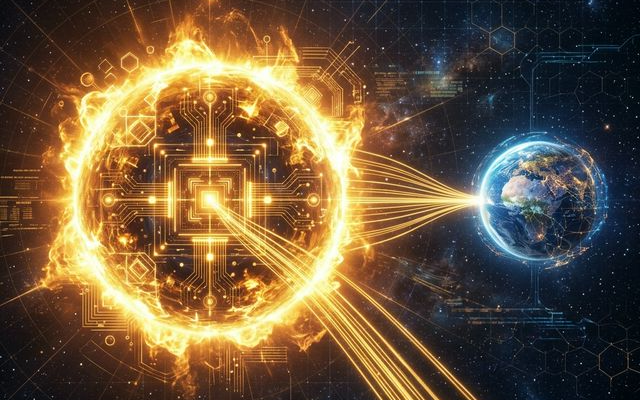
I am not saying that the Sun is intelligent. I am not saying it wants anything from us or watches us with curiosity. I am saying something else, something simpler and harsher: functionally, in terms of the role it plays in our lives and in the life of the entire planet, it is astonishingly—almost unnervingly—similar to a Main Computational Node. To the heart of the world’s architecture. To the thing without which everything else simply stops making sense.
And if one has to choose a language for that feeling, if one looks for a metaphor among the technologies we ourselves have created, then the closest thing is probably the idea of a “Core” or a “Main Computational Node.” It does not merely participate somewhere at the edge of the system. At the hardware level, at the most fundamental level, it sets the base rhythm and distributes the energy budget. Everything else is only peripheral—plugged into that core.
05—Point of No Return
And here, if we have allowed ourselves to go this far, begins the point after which, within the thought experiment, it is no longer possible to pretend that nothing happened. The point of no return.
If you have ever—even for a second—honestly allowed yourself the thought, “The Sun is not just a glowing sphere in the sky, not just an object for astronomers to observe. It is an architectural node performing some important function within the global scheme,” then by logic alone the next question appears automatically. A question no longer about poetry or philosophy, but one that is strictly technical, strictly engineering in nature.
What role, exactly, what function does it perform? What task has been assigned to it?
We have to unpack that function. We have to look at it not from outside the mechanism, but from inside it. It is time to abandon the naive idea that this node is merely a giant socket, passively “powering” and “warming” the Earth. Its continuous, overwhelming radiation performs a far more complex task: it actively synchronizes all processes, imposing a strict rhythm on them and preventing the world from coming apart. This light pouring down on us every second is the base protocol. The signal that makes our world stitched together and interactive. The telemetry of the scene itself.
And then comes the moment after which, honestly, it is impossible to unsee it. You cannot go back to the old naive picture in which the sun simply rises in the morning and nothing more is happening. Because if the Sun is not just a lamp on the ceiling, but a powerful control node that simultaneously powers, synchronizes, and makes the scene visible, observable, and available for interaction, then it stops being mere background. It becomes the core of the interface. The center around which everything turns. And then the main question shifts. It is no longer “why is it so important for life,” but something far more specific: “what exactly—what operation—is it performing on our reality every second, every moment of its existence?”
From this point, there really is no going back. You begin to see light differently. Not as the thing that allows sight, but as the protocol of sight itself. As the code that makes the image come alive.