(no lectures)
If, in the previous parts, I was trying to raise questions and look for answers, studying the function of the Sun and trying to understand its role in the architecture, then here I want to do exactly one very simple thing. Pause and simply feel the scale. Not to slam the door and declare, “The model is proven!” But for something else: to understand why a node like our Sun has every reason—every engineering right—to be dominant. Why speaking of it as the “Central Node” is not a leap into fantasy, but a perfectly natural line of thought.
Guardrail (Armor)
Armor / Important:
This part is reference material. I want to make that clear immediately so there is no misunderstanding. It does not turn any of this into a scientific conclusion or a proven theorem. Not at all. It does something else: it simply shows that the object we are talking about is in fact so vast, so massive, and so influential within our local segment of reality that speaking of its “central systemic role” no longer sounds like the ravings of a madman, but like a natural, almost self-evident engineering thought.
Below are three main facts. The simplest, most basic ones. Everything else, if you are interested, can be unpacked in detail—but for a first step, this is enough. Just enough to feel the weight.
01—Fact 1: Almost the Entire System Rests on a Single Mass
In our local universe, the Sun is not merely the “largest body.” If you look closely, it is almost everything we have. Everything else is dust, grains of sand, fragments.
- The Sun accounts for about 99.86% of the total mass of our planetary system. Not half, not three-quarters—almost all of it. The remaining planets, moons, asteroids, and comets make up a mere 0.14%, circling somewhere on the periphery, existing by the grace of this giant.
- It is approximately 333,000 times more massive than Earth. To even begin to picture that number: if you took three hundred and thirty-three thousand Earths and piled them together, they would only just equal one Sun.
What this means in human terms: a mass this colossal has not just the right, but the physical inevitability, to define the gravitational “framework” of the entire System. The Sun is not an ornament in the sky, not just a bright point we draw in pictures. It is the fundamental object around which all other bodies—Earth, Mars, Jupiter, distant Pluto—are literally forced to play out their orbits. They have no choice. The framework is set, and it is rigid.
Why This Matters for the Idea of a “Central Node”
In engineering terms, mass is not just “how much a thing weighs.” It is the capacity to dominate. The capacity to keep an entire complex structure from instantly falling apart, from flying off in every direction. When nearly 100 percent of a system’s mass is concentrated in a single point, the idea of a “center” stops being an abstract poetic metaphor and becomes a hard engineering inevitability. The System has a clear, undeniable core. A point of assembly around which everything is forced to revolve.
02—Fact 2: The Processes Inside Are Hard to Imagine
The second fact concerns what is happening inside. The Sun is not “burning” in the way a campfire or a candle burns. We simply do not have an everyday word that really fits what is happening there. It is a continuous thermonuclear fusion process lasting billions of years.
- At the very center—in the core—the temperature reaches truly extreme values, around 15,000,000°C. At that level, the familiar laws of chemistry and the ordinary states of matter cease to apply. Matter loses its structure, becoming pure dense plasma—an ideal medium for thermonuclear fusion, where the basic energy code of the entire System is born.
- And it is there, in that inferno, that the main event happens every second: hydrogen turns into helium. And in that transformation, virtually all the energy that powers our local System is born. All of it, without exception.
What this means in human terms: this is not a one-time event, not a random flash, not a temporary phenomenon. It is a rigid, relentless operating mode. A mode sustained for billions of years at the hardware level. What stands before us is not just a “lamp” that can be switched off if it gets too bright. It is an immense, stable source of generation that operates regardless of our plans, desires, or ideas about how things ought to be.
Layers and the “Temperature Paradox”
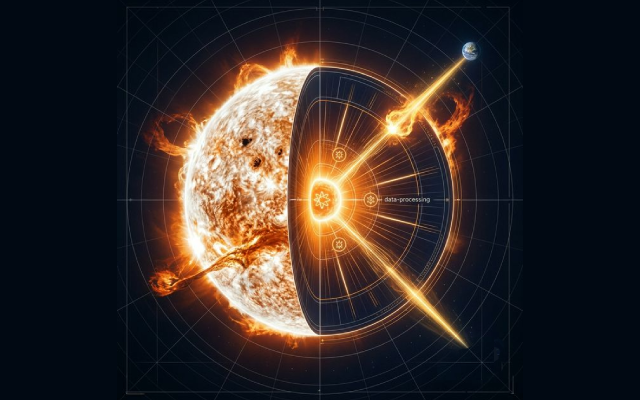
If you look a little deeper, the Sun can be imagined as a layered architecture, with each layer performing its own function.
- Core—the zone of extreme fusion, the heart where everything happens.
- Photosphere—what we, standing on Earth, perceive as the Sun’s “surface.” The thing that hurts to look at. Here the temperature falls to a comparatively modest ~5500°C.
- Corona—the outer atmosphere, extending far into space. And here begins the strangeness physicists call the “coronal heating problem.” Contrary to intuition, as you move farther from the scorching core, the temperature does not fall—it rises again, up to 1–2 million degrees. The mechanism behind this heating is still not fully explained.
This fact of the “hot corona” matters here not as a mystery for mystery’s sake, not as a chance to show off erudition. It is simply a reminder: even at the level of classical astrophysics, where everything seems measured and calculated, we are dealing with an incredibly complex system of energy transfer. A system in which not every process is yet fully understood or explained.
03—Fact 3: Light Is Not Just Heat. It Is Born Slowly but Arrives Fast
And the third fact is about light. About what we see every day. There is one detail here that, if you really think about it, may be the most astonishing of all.
- A photon—that very particle of light born in the Sun’s core as a result of thermonuclear reaction—takes an immense amount of time just to get out. Scientists’ estimates range from tens of thousands to hundreds of thousands of years—the order of magnitude matters more here than the exact number. During all that time, the photon wanders inside, colliding with particles, being absorbed and re-emitted again and again, forcing its way through dense, opaque plasma toward the surface. It is a long, punishing journey.
- But once that radiation finally breaks free of the photosphere, once it becomes truly free, it travels to us at almost the speed of light. And it covers the distance of 150 million kilometers in just 8 minutes 20 seconds. A little over eight minutes—and the signal that took millennia to emerge touches your face.
What this means in human terms: for us, observers on Earth, the Sun appears as a source of an almost instantaneous external signal. The moment it rises above the horizon, the whole scene suddenly fills with color, shadow, and depth. The reaction seems immediate, as if we had simply pressed the power button on a monitor. But this 8-minute packet of data, this fast signal, actually rests on a colossal internal “computational workload” that never stops inside the core.
Why Does This Matter for “Architectural” Thinking?
This physical detail gives us a vivid, almost perfect metaphor for separating the “internal computation of the node” from its external interface—the part accessible to us.
Inside the core, an ultra-dense, immensely complex physical process unfolds over spans of time measured in millennia. It is hot, dark, and endlessly long. But what gets transmitted outward, to the periphery, is a perfectly clear, standardized, unchanging stream of photons. A signal of the same power, the same structure. And that stream, reaching us in only a few minutes, instantly becomes the basic environment for the entire peripheral system: for the atmosphere, for climate, for biology. This is a classic engineering configuration: the heavy, long, complex computation happens inside—at the node itself—and then the finished render is delivered outward, quickly, without lag or failure, to the clients. In this case, the clients are the whole Earth.
04—Optional Depth
If the basic facts are not enough for you as a reader, and you want to go a little deeper, here are a few more details. This is no longer required reading, but material for those who like to dig into the finer points.
Additional: Life Cycle
- The age of our source at this point is about 4.6 billion years. A number so large it is hard to connect it to anything tangible.
- At present, the Sun is roughly in the middle of its stable, even, predictable working life. It is neither a young star nor an old one—it is in its prime, if such a word can even be used for a star.
- The future scenario predicted by astrophysicists—in billions of years, when the hydrogen in the core runs out—involves dramatic expansion. The Sun will enter its red giant phase, swelling to unimaginable size, and then shed its outer layers. Of the colossal node, only a small, dense core will remain—a white dwarf. A basic framework that will cool slowly over billions of years.
Influence Beyond Light—Solar Wind
It is important to understand that the Sun’s influence is not limited to the visible light we see with our eyes. That would be too simple. It sends more than photons into space.
- The Sun constantly emits what is known as the solar wind—a powerful stream of charged particles, protons and electrons, spreading outward in all directions at supersonic speed.
- In addition, the entire heliosphere is permeated by the star’s immense magnetic field.
This matters for the sake of a complete picture. The Sun’s influence is not just a passive indicator light by which we tell the time of day. It is an aggressive, living, pulsating electromagnetic environment. An environment with which Earth’s magnetic field interacts in real time, every second. It is that field that protects us from the harshest forms of space weather, from the radiation that would make life on the surface impossible. This is not a static background. It is a dynamic interaction.
05—Conclusion of the Series
After a reference like this, after simply laying out dry facts without inventing or embellishing anything, it becomes difficult to look at the sky with the same everyday simplicity. Difficult to return to the image of a “lamp” just hanging in the background. We are dealing with an object that, when everything is put together, looks very different.
This is a node that:
- Totally dominates by mass. It is not merely larger—it is almost the entire system. Everything else is just dust on the periphery.
- Operates continuously as a colossal thermonuclear reactor. Inside it, processes unfold that we can barely imagine, and they have gone on for billions of years without stopping.
- Generates and emits a stable, broadband stream of radiation. A stream that reaches us in just eight minutes and quite literally unfolds our reality. Makes it visible, warm, alive.
I will repeat once again, so there is no misunderstanding: this is still not proof of any metaphysics. We have not leapt into the miraculous. We remain within the bounds of strict logic and observable facts. We have not taken a single step beyond the edge of science.
But this set of facts—this reference—is already enough to make the next step in our thought experiment look not like a fantastical assumption, but like an entirely natural, almost inevitable conclusion.
If an object so totally, so comprehensively dominates everything that happens within its zone of influence—if absolutely everything depends on it, from planetary orbits to the structure of DNA—then it must have a clear, describable, concrete function within the architecture of the entire System. It cannot be just a random accumulation of matter. It is too vast for randomness. It is too important to be decoration.