The Node does not always stay in “quiet” mode. Sometimes it takes hard actions—reconfigurations and buffer flushes. And then the natural architectural question arises: if a system is capable of structural reconfiguration, does that mean it has memory of its own configuration? Does the Node have states that persist long enough to shape its future behavior?
Safeguard
Armor / Important:
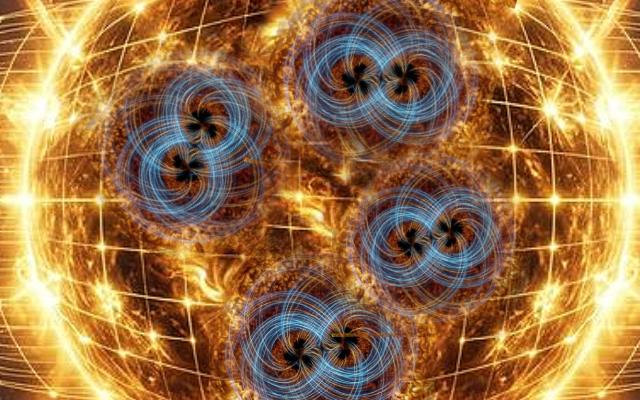
I am not claiming that the Sun “remembers” its states in the way an intelligent agent would. I am talking about a measurable and verifiable phenomenon: in plasma physics, there are long-lived magnetohydrodynamic configurations that behave like system memory—as a retained operating mode.
The word “memory” immediately pulls in human associations: a hard drive, an SSD chip, a silicon crystal. Something solid, where bytes of information sit motionless. But that is only one special case of the underlying logic. We often confuse the carrier of information with its form.
01 — Memory Does Not Have to Reside in the Same Atoms
Imagine a powerful whirlpool in a mountain river.
The water in it is never the same from one second to the next: H₂O molecules continuously arrive from upstream and leave downstream; the material inside it is constantly replaced. But the whirlpool itself—as a mathematical form—can remain stable for years, as long as the system’s basic parameters remain in place: flow pressure, the shape of the riverbed, and velocity.
This is where the key engineering principle appears:
Armor / Important:
Information does not have to live in a specific piece of matter. It can live in the organization of a process. Not in what exactly is flowing, but in how exactly it is arranged and twisted.
That is how many natural architectures work: vortices, acoustic waves, ocean currents, atmospheric fronts. You will not find the “same” nitrogen molecule in a cyclone, but the cyclone itself can maintain its topology for weeks. Because what is preserved is the form of organization, not the particular matter.
02 — The Sun as “Liquid” Memory: Plasma and Field
The Sun is not a solid-state storage device like a flash drive. Its substance is superheated plasma that boils, flows, and continually rises in convective currents.
If we continue the architectural metaphor, then:
- plasma is simply the moving carrier—the raw material;
- the magnetic field is the structure: the architecture that gives that motion its form.
In highly conductive plasma, the magnetic field is largely “frozen into” the flow, which is why large-scale magnetic patterns outlast the individual particles of matter passing through them. The magnetic field is not something that “sits inside” like an object. It exists physically as a configuration: tension, intersecting field lines, complex topologies, and patterns. And these magnetic patterns can be astonishingly stable, even when trillions of tons of plasma have already passed through them and been replaced by new flows.
Armor / Important:
This is how the concept of dynamic memory appears in physics—when data is stored as an active regime, not as a dead thing in an archive.
03 — Why Chaos Does Not Destroy This Kind of Memory
My inner skeptic quite reasonably objects: “What kind of memory are you talking about? Everything there is boiling, mixing, and burning.” And that is an honest engineering question. The topology ought to fall apart.
But in complex nonlinear systems, chaos—turbulence—sometimes acts not as a destroyer, but as a distributor. Solid-state memory like an SSD is reliable only until physical damage arrives. It has hard failure points—single points of failure: one microcrack in the crystal, and a data sector is gone forever.
Solar “liquid” memory is built in a fundamentally different way:
- it does not store data in one localized place;
- it stores it in a distributed way throughout the volume—through the global configuration of the field and flows (the solar magnetic dynamo).
You cannot “break” a river whirlpool by striking it with a stick at one point. You may locally distort its hydrodynamics, but if the underlying gradients remain, the whirlpool will restore its topology. And at that point the star’s boiling stops being an argument against memory. It becomes part of the hardware fault tolerance.
Armor / Important:
Solar memory self-restores because its foundation is not a static object, but a restoring gradient.
Armor / Important:
Architecturally, this is even stronger than the idea of an “ideal storage device”: what is more reliable is not what is motionless and armored, but what can continuously rebuild itself.
04 — Sunspots as Field Telemetry
Now let us step down from the abstractions of magnetohydrodynamics to something any observer in the Solar System can see—sunspots.
In standard physics, a sunspot is a local region where the star’s outward-emerging magnetic field has become so strong that it suppresses the convection of plasma from below. The surface there is not heated as efficiently from within, becomes a thousand or two degrees cooler than the surrounding areas, and therefore appears to us as a dark patch.
In the language of my IT model, the same thing can be stated more precisely:
Armor / Important:
A sunspot is a place where the internal magnetic structure has become so dense that it manifests on the external interface—in the photosphere.
No text is written here. There are no secret runes. The field configuration has simply become strong enough to appear at the surface, and it has changed the basic operating mode of the matter. The plasma no longer “flows freely”; it is forced to obey the rigid pattern of magnetic flux. And we see that disruption in radiation as a visible difference—as an imprint of the internal structure.
Put simply: a sunspot is the visible trace of an internal magnetic pattern that is normally hidden from view.
05 — Cycles: Memory Does Not Sit Still, It “Breathes”
These spots appear and disappear. Their sizes and locations change. There is the famous 11-year Schwabe cycle of solar activity, along with the full 22-year Hale magnetic cycle, in which the Sun’s magnetic poles fully reverse and then return.
And this is critically important: if “solar memory” were a static archive like a MySQL database, it would simply sit there doing nothing.
But magnetic structure does not exist as an archive; it exists as a cyclic regime. And here the comparison shifts from a hard drive to another dynamic system: the human brain also does not store memories like files on a flash drive. Neural ensembles retain them through ongoing electrical activity: through constant synaptic rewiring, recurring impulse patterns, and the reassembly of larger structures. Human memory remains alive only as long as physical processes keep rewriting it. That does not make the Sun “thinking.” But it does place it in the same broad class of systems where memory exists as a dynamic regime rather than a static archive.
Armor / Important:
A star’s “memory” exists only as long as processes keep turning inside it. In solar dynamo physics, a key role is played by the tachocline—the layer where differential rotation creates the conditions for long-term storage and reassembly of magnetic configuration. Memory here exists as a rhythmic regime of reassembly.
06 — Flares as “State Rewriting”
Now this can be tied directly to the earlier scene about flushing overloaded buffers. When we said that the Sun performs “hard actions” (ejections and flares), an important clarification follows: what exactly is being flushed? Not only energy is being discharged—the twisted topology of the field itself is being simplified.
For years, magnetic lines are stretched, twisted by turbulence, and braided because the star’s equator rotates faster than its poles. The tension in magnetic knots grows to the limit. And at the moment of a flare, magnetic reconnection occurs: the field abruptly breaks and reassembles into a simpler, more relaxed, and more energetically favorable configuration.
From the outside, Earth receives a burst of radiation and a blow of heavy particles. Inside the architecture, this looks like a cycle of state rewriting:
- the old twisted pattern reached its stability limit;
- a hard reassembly of the magnetic configuration took place;
- the local configuration of magnetic memory reduced its twist, released its tension, and reassembled into a simpler, more energetically favorable form.
07 — The Architectural Meaning of Solar Dynamics
If we look at the Sun as the Central Node, why does it need this multi-year dynamic “memory” of cyclic states at all?
In the functional language of IT, it is needed in order to:
- sustain long, rhythmic operating modes (cycles spanning decades);
- carry system configurations across periods of quiescence and activity;
- serve the enormous domain of the heliosphere not through one-off bursts, but across long macroscopic stretches of time.
And the star’s magnetohydrodynamics sustains this role with astonishing stability precisely because it is not tied to any specific raw material.
The plasma may boil, stream outward, and be ejected into space, while the Node’s magnetic structure continues to persist, grow more complex, twist, and cyclically rebuild itself over billions of years.
Chaos on the Sun stops looking like chaos. Architecturally, it becomes nothing more than high-frequency thermal noise on the surface of a deep mathematical order.
As in the ocean: chaotic whitecaps crash at the surface, while in the depths, global currents flow on for centuries and millennia without disturbance.
08 — Scene Summary
If we reduce the concept to one clear systems-level formulation:
The Sun remembers its states not like a human being and not like a hard drive. It remembers them physically—through long-lived, self-restoring, and cyclically reset configurations of the magnetic field (the solar dynamo), which in the literal sense define the behavioral regime of billions of tons of active plasma.
Armor / Important:
Cosmic memory is a structural, rhythmic pattern, not a warehouse of frozen matter.
09 — A Bridge to Auditing the Periphery
And now, in our architectural model, an entirely new layer appears—the layer of receiving terminals.
If the system, on a global level, has:
- an immensely powerful outgoing hardware flow;
- a rigidly maintained regime of hydrostatic balance;
- an enormous protective domain at the periphery;
- and an extremely complex internal memory of cycles spanning years…
then we inevitably run into a very pragmatic question: what does the budget look like for those sitting at the periphery of this communication channel and consuming its traffic?
We, as Earth’s biosphere, are one of very many terminals at the edge of this network. We physically live inside the Node’s outgoing flow and exist within a specific, measurable share of its throughput.
And then the next architectural step stops being a beautiful piece of popular-science speculation and becomes a strict engineering necessity: we have to conduct a hard systems audit of what we call “life.”
Armor / Important:
“The Sun’s magnetic memory is a pattern of processes that restores itself through the chaos of plasma.”
Next: The Solar Energy Consumption Law (Solar Bitrate Law). A hard audit of throughput: what the “bitrate of life” looks like in a star’s channel, and why this architecture contains nothing free of charge.