When you look at how the body’s internal processes are organized—from cell division to the structure of DNA—it takes your breath away. The gap in complexity between “lifeless sand” and a “living cell” is so immense that the usual mechanical explanation starts to crack.
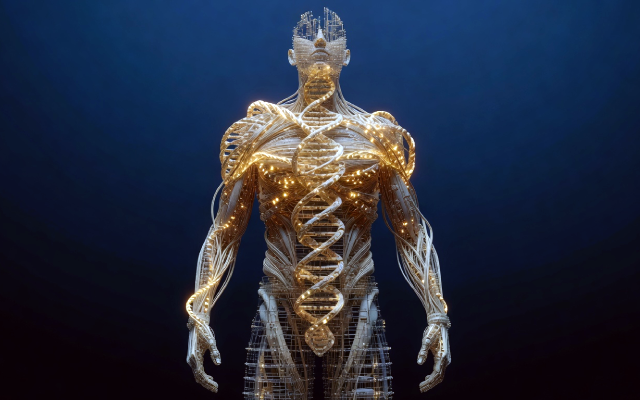
How did a biological avatar assemble itself out of a chaotic set of atoms, out of randomly mixed chemical elements? A being capable of seeing, hearing, feeling, becoming aware of itself, remembering the past, and planning the future? How could such a complex living system arise at all from nonliving chemistry—from water, minerals, and simple molecules?
01—The Safeguard
Armor / Important:
I am not asking anyone to believe in magic. I am not dismissing biology, and I am not crossing out evolution. Evolution exists—it is a magnificent background process that adjusts the design to changing environmental conditions, discards failed variants, and preserves successful ones.
But the engineering lens—the perspective I am using here—pushes me to look deeper. DNA and cellular architecture look like an astonishingly complex, pre-coordinated platform. Ready to launch. Even if science explains its emergence through prolonged self-organization, even if that process took billions of years, the very idea of how something like this could assemble itself out of the nonliving remains, to me, the central miracle.
02—Wetware: Why We Are Not Made of Metal
If classical biology explains the emergence of complex organisms as the result of random mutations and long, ruthless selection for successful variants, a systems lens asks a different question. A simpler one.
If you were designing an autonomous agent from scratch, how would you build it?
Building out of metal and silicon is simply not viable. Iron rusts. Microchips require stable voltage, clean rooms, and factories capable of producing replacement parts. If a component breaks, it has to be replaced. No factory—no agent.
Nature—or the engine I am talking about—found another solution. Self-assembling nanotechnology. Our body is living matter that assembles itself, repairs itself, and heals its own damage. You get cut—the wound closes. You break a bone—it fuses. Cells renew themselves every few years. And all of it runs on ordinary organic matter: water, carbohydrates, fats, proteins. No factories. No warehouse parts.
And DNA, seen through an engineering lens, looks like an ultra-dense data storage protocol. A single gram of DNA can hold hundreds of petabytes of information. It is an extraordinarily dense biological record the organism uses to build and maintain itself. Its density and reliability were refined over millions of years. Evolution worked like a ruthless optimizer, discarding failed variants and preserving the ones that performed better.
03—Why Does It Take Two to Make a New Human?
If you really think about it, a strange question appears. Why does it take exactly two people to produce a new human being? A man and a woman. Why not some other way? Why did nature not choose a simpler route—splitting in half, as bacteria do, or asexual reproduction, as many plants use?
In IT architecture, in the language I use, the answer sounds like this: it is a question of code stability.
Imagine that complex multicellular life reproduced through simple cloning. It would just copy itself. That is like making endless copies of the same software. If there is an error in the source code—and errors happen constantly; that is what mutations are—then that error will be copied into every next version. Endlessly. Without interruption. The system will accumulate bugs until it finally freezes for good. Until it goes extinct from the very errors it kept accumulating.
Two sexes are a solution to that problem. It is an effective mechanism for cross-checking data. In programming, this is called a Merge Request. A request to merge.
One developer writes code. A second developer writes code. Each brings their own code, their own bugs, their own elegant solutions. Then the two versions come together. The organism receives genetic material from two parents, shuffles it, and creates a new combination of traits. That does not guarantee “the best” result, but it sharply increases the diversity of variants from which selection can then preserve the more successful ones. And the output is a new version. Not a copy, but a hybrid. One that proves more resilient than either parental branch on its own.
This is a built-in algorithm. It allows complex life to avoid degeneration. To update quickly under external pressure. To discover useful combinations of traits that can survive where older versions no longer can. This is not an accident. It is an architectural solution.
04—Which Came First: The Chicken or the Egg?
Here I am already stepping out of strict science and into the realm of an architectural thought experiment. If you look at life as a system, you can imagine two scenarios: a long evolutionary assembly, or a one-time launch of a ready-made model. Science works with the first scenario. I am only showing here why the second arises so easily in the human imagination.
There is an old philosophical question that has haunted humanity for thousands of years: which came first—the chicken or the egg? In my architectural model, in the language I use, that paradox is resolved quite simply. Through the idea of a first launch.
Imagine that you are a developer building a complex system. You can let it evolve for billions of years, watching simple molecules assemble into more complex ones, single-celled organisms give rise to multicellular ones, life crawl out of the ocean onto land, learn to breathe, learn to walk, learn to think. That is a long road. It requires patience.
But there is another way.
You can load a finished reference model. You can take an assembled, tested, working sample—and launch it. Ancient myths describe this through the image of the first humans, created ready-made: Adam and Eve. They did not pass through the full evolutionary path from amoeba to human. They appeared with the full feature set already in place.
From a designer’s point of view, that is the fastest and most reliable option. No need to wait a billion years, hoping everything comes together on its own. Just take a finished template with the physics already tuned and the scripts already working. Load it into the system. Then just press “Play.” And let natural reproduction, mutation, selection—that same evolution—take over and keep adjusting the code to changing conditions.
So what is the answer to the question, “The chicken or the egg?” In my architecture, the chicken comes first. Ready-made. Then it starts laying eggs.
05—Why We Need Such a Complex Body
Why would anyone need such an unimaginably complex device at all? Hundreds of bones, thousands of muscles, billions of nerve cells. Why not make it simpler? Why not settle for something like a worm that crawls and eats, or a fish that swims and spawns?
The answer lies in why the Agent is needed in the first place. In its task.
The body is not just a carrier. It is an interface. A terminal device that receives signals from the outside world and translates them into what we call experience.
Seen through this lens, the brain can be imagined not only as a source of processing, but also as a complex biological interface that receives, binds, and transforms the incoming stream of signals. And the body determines exactly what kind of data stream you are capable of receiving and processing. It determines the depth of your experience. Its level of detail.
An earthworm has a primitive body. It has no eyes, no ears, no complex nervous system. Its modem can receive only the simplest signals: light or dark, wet or dry. That is all. It does not know what red looks like. It does not hear birdsong. It does not taste an apple. Its world is astonishingly poor compared to a human one: few distinctions, few channels, little depth.
A human being has a complex body. And that is why its modem can receive a colossal stream of data. Color spectra—millions of shades. Stereo sound—a spatial, directional sound field. Complex emotions assembled out of thousands of signals at once. Abstract mathematics that can be represented and held in the mind, even though it does not exist in pure form in nature. All of that requires a complex interface. A complex body.
Armor / Important:
In the human body, if you look closely, there are almost no redundant details. For example, many noncoding regions of DNA that were once labeled “junk” turned out to be important regulators. They do not build proteins directly, but they help govern how the rest of the genome operates.
06—Who Runs the Body While I Am Thinking?
Earth is the hardware platform. Our biological bodies are extraordinarily sophisticated bio-avatars. They have eyes, ears, skin—open ports through which the world pours data into us. DNA is the code, the base firmware that unfolds into a living organism. And we are here as autonomous users. Agents who came into this world to learn, act, and leave a trace.
But if the body is such a complex interface, one question immediately appears. A question people usually do not ask, because we are so used to taking it for granted.
Who runs its background processes while we are busy thinking?
Here you are, sitting and reading this book. Your consciousness is occupied with what I am writing. You follow the meaning, argue with it internally, agree, get indignant. And all the while, your heart is beating. Thumping in your chest, pushing blood through your vessels. You are not thinking about it. You are not issuing the command, “make the next beat happen.” It does it on its own.
Your lungs are breathing. Taking in oxygen, releasing carbon dioxide. Automatically. Without asking permission.
Digestion is processing the breakfast you ate hours ago. The intestines absorb nutrients, the liver filters the blood, the kidneys remove waste. A vast, complex conveyor system. And you are not running it. You do not even know how it is built.
Wounds close. Cells divide. Old ones die, new ones take their place. Body temperature stays within a fairly narrow operating range.
Who is managing all of that? Who keeps this colossal mechanism running while we sleep, read books, fall in love, argue, make plans for the future?
We are used to thinking that we control the body. That consciousness is the main command center. But if you look more closely, consciousness is like a passenger in a highly advanced vehicle. It can tell the system where to go—for example, to raise a hand, pick up a cup, take a step. But the engine, the wheels, the brakes—everything happening under the hood—works entirely on its own. So who is actually driving?
That is probably the next conversation.
Next: How do we breathe, digest food, and heal wounds without conscious control? A look at the architecture of the biological autopilot.