We have an important architectural picture here: a domain is deployed around the Central Node—a hardware envelope of influence, a zone with its own rules. We talked about this in the previous chapter. But this is where it is easy to make a conceptual mistake, and a common one at that. It is easy to imagine that the domain “just exists.” Like the air in a room that has always been there and always will be. Like a static brick wall that simply stands there, unchanged, with nothing happening to it.
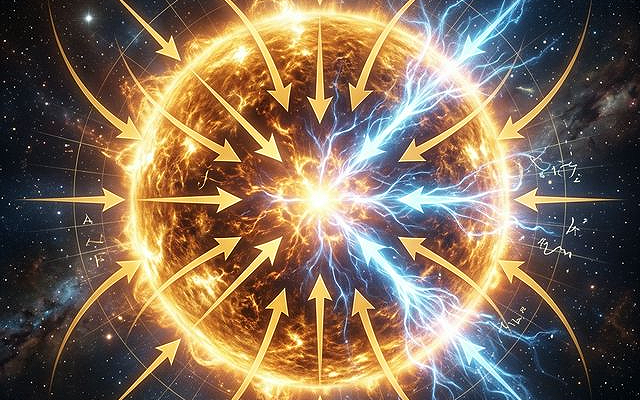
In reality, if we want to think honestly and architecturally, we need to understand one simple thing. Nothing “just stands” at this scale. No structure, no bubble, no envelope sustains itself for free. Any complex organization requires resources to maintain itself. It requires energy. It requires work.
Safeguard
Armor / Important:
This is strictly an engineering and systems metaphor. I am not attributing reason, will, or conscious management to the Sun. I do not think the star “wants” to maintain equilibrium or “tries” not to fall apart. I am describing a measurable, verifiable self-regulating function—the kind that, in physics, has a specific name, a specific formula, and a mathematical foundation. No mysticism involved.
01 — What Physics Calls Stellar Stability
Physicists call the basic condition for a star’s existence hydrostatic equilibrium. The term is technical, but the idea behind it is simple and elegant.
Inside a star, there is a force pushing outward. That force is the pressure gradient—the difference between the pressure at the center and the pressure farther out. Superheated plasma and enormous temperatures drive expansion, trying to tear the star apart, to scatter its matter across space. Opposing that is gravity, pulling all that mass inward toward the core, trying to compress the star into a point, to make it collapse under its own weight.
A star exists only as long as those two forces remain in balance. As long as the outward push from within exactly matches the inward pull of gravity. No more, no less.
And thermonuclear reactions in the core are not just “burning” in the everyday sense. They are a physical energy source that maintains the required temperature. And that temperature, in turn, creates the pressure profile that withstands gravity’s pull. It is a closed loop—but a functioning one.
In the language of engineering, in the language of systems, the picture becomes even clearer.
The Sun is a giant mass of matter that is continuously, every second, trying to compress under its own weight. This is the system’s collapse mode. Gravity never takes a break.
And at the same time, it is superheated plasma that is constantly, with equal force, trying to expand and tear itself apart. Because thermonuclear reactions are happening inside it; because extreme temperatures and pressures are at work. This is the system’s overflow mode, its drive toward rupture.
Two catastrophes. Two abysses. And the Sun has hung precisely between them for billions of years.
Armor / Important:
The systems formula for stability looks like this:
Gravity (inward pull) ≈ Pressure gradient (effective outward push)
An elegant mathematical “Easter egg” here is a single simple equation:
$$\frac{dP}{dr} \approx – \frac{G \cdot M(r) \cdot \rho}{r^2}$$
Its physical meaning is straightforward: the moment the pressure profile starts to sag, the system immediately begins to contract.
02 — Two Poles: Collapse and Overload
There are two absolute extremes in this system, two failure scenarios:
- Gravity — “the drive toward zero” (Collapse). If gravity alone were at work, the system would collapse: all mass would be pulled inward toward the core, density would rise to critical levels, and the regime would tip into gravitational collapse.
- Pressure — “the drive toward overflow” (Overflow). If pressure alone were at work, the plasma star would instantly expand and lose its internal coherence: the envelope would become unstable, and the structure would break apart into chaotic fragments.
Between these hard physical extremes lies a corridor, tightly defined by the system’s mass and composition—a stable operating regime. Leave that corridor, and the current architecture fails, transitioning into a qualitatively different class of object.
Armor / Important:
This corridor does not sustain itself “automatically,” like a stone statue in a park. It is sustained the way balance is sustained on a bicycle, or the way a drone stays level in the air through dynamic stabilization: as long as you are working, and spending energy to correct deviations, you remain stable.
And notably, this dynamic stabilization—contraction or expansion—happens physically fast, on the scale of minutes to hours. Thermal and energetic balancing is much slower, while nuclear evolution belongs to an entirely different timescale.
The system does not simply “sit” between the extremes. It is constantly pushing back against them.
03 — Stability Is Feedback
In everyday language, we often think of stability as something frozen. Like dead calm—nothing happens, nothing changes, everything stands still. Silence and rest.
But in engineering reality, in the world of functioning systems, stability means something entirely different.
Armor / Important:
Stability is the proper functioning of physical feedback. It is not “silence” in the sense of nothing happening. It is an endless, ongoing cycle of error correction. The system is not frozen—it is continuously adjusting, continuously returning itself to its operating state.
Let’s look at how this works inside a star.
If the pressure in the core weakens slightly, if thermonuclear fusion slows down a little, gravity immediately—without pause—begins compressing the star more strongly. Give it the slightest opening, and it acts. That compression, in turn, immediately raises the temperature and density at the center. And temperature and density directly regulate the reaction rate. Fusion speeds up, energy release rises sharply, outward pressure strengthens again—and the system pushes itself back toward equilibrium.
If the pressure becomes too strong, if the reactions accelerate too much, the star expands slightly. Gravity may not like that, but it cannot stop it. As the star expands, temperature and density in the active region fall. The reactions slow down. Pressure correspondingly decreases. And once again, the system returns to the balance point.
This is not “drifting wherever the random wind happens to take you.” This is continuous physical work happening in real time. Deviation correction. The system is always slipping slightly away from equilibrium—and always pulling itself back.
In classical thermodynamics, these mechanisms have long been described by the principle known as Le Chatelier–Braun. Put simply: when an external influence tries to push a system out of equilibrium, the system shifts in a way that weakens or compensates for that influence. That is exactly what is happening here.
If the feedback breaks, stability disappears immediately.
04 — What This Means for “Solar Architecture”
Now, after talking about feedback and equilibrium, we can return to where this chapter began: to our domain, to the heliosphere.
The system has this enormous envelope, this filtering zone that shields against external radiative noise. It is real, it works, it protects the entire inner space. But a structure like that cannot be “cheap” in energetic terms. It does not simply hang there in space as a gift. Its existence—its budget—is sustained by a continuous supply from the center. By streams of solar wind, by the magnetic field, by coronal processes. By everything that projects this hardware domain far beyond the planetary orbits.
And from that follows one simple but important conclusion.
The heliosphere—our protective bubble—exists only as long as the Central Node exists. Not merely “exists” as a dead mass, but functions. As long as it is able to:
- physically, without interruption, maintain a stable outward flow of particles;
- hold its internal physical regimes firmly in place through those same feedback loops;
- withstand colossal, almost unimaginable loads while shedding excess stress without destroying itself;
- remain structurally intact—without falling apart—for a span of time that matters on the scale of the universe.
Armor / Important:
A star is not just a place in space where something burns brightly. It is not a hearth. It is not a lamp.
A star is a regime. A regime that, second after second, never stops holding itself together. On an extremely narrow boundary. Between two catastrophes. Between total collapse, when gravity wins and everything is crushed into a point, and uncontrolled rupture, when pressure breaks outward and scatters matter across space.
The domain is a byproduct of a stable regime.
05 — The Sun’s Existence Is an Action
And this is where the formulation appears that I want to fix in place:
Armor / Important:
The Sun is not an object. The Sun is a process.
Its ability “to be” is the continuous mathematical act of holding balance.
You can read this purely as astrophysics, and that would be the most honest reading. But I can also see why this rock-solid fact fits so perfectly into the language of systems architecture.
All computational and control systems in IT also “live” only as a regime. Program code or a server in a rack do not “exist” the way a stone by the roadside exists—they operate in a cycle. And if that cycle stops—through power loss or a system hang—the very “normal mode” users are used to taking for granted disappears instantly.
06 — A Caveat Against Dogma
When I write that “the equation of stability is being solved continuously,” I do not, of course, mean that someone is sitting inside the star with a slide rule, “making decisions” like a rational actor. Physics has no need for a thinking observer with a calculator in order for a system to remain balanced.
What we have is simply this:
- measurable parameters (mass, temperature, density);
- a fundamental physical law;
- a built-in negative feedback loop;
- and a stable regime that emerges from that physical coupling.
No will. Just pure function.
07 — Transition to the Next Scene
If we look at the Sun as a system that never stops holding itself in a hard equilibrium, then the next technical question becomes unavoidable:
What happens when it becomes physically impossible for the system to maintain that regime smoothly and gently? What does the moment actually look like when excess stress has built up inside the node, local load has risen beyond the norm, and architecturally it becomes easier for the system to perform a sharp, destructive action than to keep endlessly smoothing the error inside itself?
Armor / Important:
“The Sun is not an object but a process. Its ‘being’ is the continuous act of holding balance. And stability is the proper functioning of feedback.”
Next: Hard actions: ejections as the infrastructural price of stability. Flares, prominences, coronal mass ejections—as emergency buffer dumps and forced load redistribution.