If, for a moment, we adopt the lens I have been building—the Sun as a central node, light as a shared channel—then a natural expectation follows. A node on this scale, through which monstrous flows of energy pass, cannot be perfectly smooth and calm at all times. Not because it has moods, but simply because any real system under such loads operates in different regimes. There are peak hours, and there are quiet periods. There are surges, and there are lulls.
Armor / Important:
I am not trying to turn the Sun into a capricious deity that gets angry and sends storms at us. Nothing of the sort. I am simply noting facts that astrophysicists already know: a star’s activity changes, those changes are measurable, and they have consequences for Earth. In science, this is called “solar activity.” And in the systemic metaphor I am using, it can be described as interrupts and noise in the channel. Nothing more.
01—Spots: Signs of Strain
Sunspots are regions of intensified magnetic field. Dark marks on a bright disk.
In reality, these are areas where the star’s magnetic field becomes especially strong. That field suppresses the rise of hot plasma, so the temperature there is lower and the region appears dark.
What matters is not the spot itself, but what it signifies.
Armor / Important:
A spot is a visible sign that, in this location, the star is operating in a different, more strained regime. Something here is wound tight, stretched, compressed.
It is like a red warning light on a dashboard. It is not the failure itself, but an indicator: “attention, the load here is higher than usual.”
Spots do not attack us. They do not send evil rays. They simply show that, right now, in this zone, the system is working near its limit. How that will echo out at the periphery is a separate question.
02—Flare: A Fast Pulse Without Intent
A solar flare is a powerful burst of electromagnetic radiation, including intense X-rays and ultraviolet light. It is always associated with a sudden release of magnetic energy in those same active regions we see as spots. It may last anywhere from a few minutes to several hours.
The key fact is this:
Armor / Important:
Radiation from a flare travels at the speed of light. Its direct hardware-level effect on the sunlit, daytime side of Earth appears about eight minutes later—that is roughly how long light takes to travel from the Sun to our planet. By human standards, that is almost immediate. Ionization in the ionosphere rises quickly, and this almost always leads to radio interference.
In systemic terms, it looks like this: a flare is a sudden surge of hard-radiation traffic in the channel. And this matters. It is not a “message” that someone sent with meaning embedded in it. It is not a “warning” to be deciphered. It is simply a fact: in the stream that is always flowing, the high-energy component has suddenly become much larger. And the receiving terminals—our instruments, the atmosphere, people—are built in such a way that they are forced to respond. They have no choice.
03—CME: A “Heavy Packet of Matter”
There is another phenomenon that is often confused with flares, though the two are different in nature. These are coronal mass ejections—in astrophysics, they are called CMEs, from Coronal Mass Ejection.
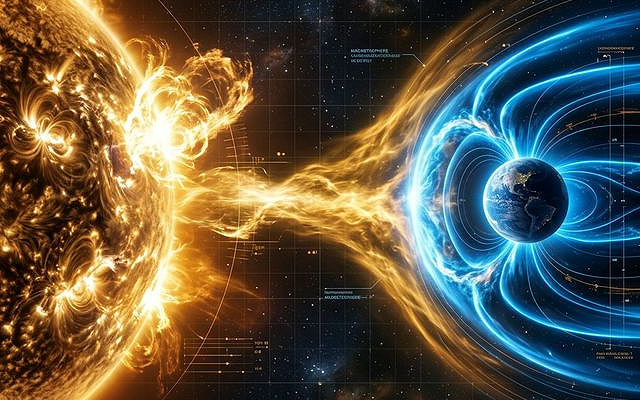
A flare is a fast pulse of radiation. A CME, by contrast, is a slower but heavier blow delivered by matter and field. In such an event, a huge cloud of plasma is hurled into space, and with it goes an embedded magnetic field. This plasma packet, this clot of matter, moves outward at its own speed. And if the direction happens to be right—if the ejection is aimed toward Earth—it may very well reach us.
Here we begin to distinguish between two fundamentally different kinds of impact, two different layers of connection.
Armor / Important:
Flare—an almost instantaneous pulse along the “light/radiation” line. It travels at the maximum possible speed, the speed of light. Eight minutes, and the receiver on the day side gets the dose.
CME—an effect of physical “delivery” along the “matter/plasma/field” line. It is a heavy packet, moving far more slowly than light. It takes time to cross the distance.
Fast CMEs, if they are aimed directly at Earth, can arrive in a matter of tens of hours. Sometimes in less than a day. By terrestrial standards, their speeds are enormous—thousands of kilometers per second. But compared with light, they are still slow.
A CME is not a second letter, not a duplicate of the same message. It is an entirely different layer of connection. A large, heavy kinetic packet that physically reaches Earth, slams into its magnetosphere, and strikes it directly—not with a signal, not with radiation, but with mass and field.
04—Geomagnetic Storms on Earth
When these heavy flows—enhanced solar wind and massive CME packets—reach Earth and collide with its magnetosphere, geomagnetic storms arise. And those storms can do very concrete, tangible things.
They can produce what are called geomagnetically induced currents. The term sounds complicated, but the meaning is simple: changes in the magnetic field generate currents in long conductors, including power lines. And those currents can overload transformers and knock them out of service. We know this from reality, not theory. The classic example is the Quebec blackout of 1989, when an entire province lost power because transformers were damaged by such a storm.
They can disrupt satellite navigation. GPS, GLONASS—all of these systems depend on signals passing through the ionosphere. And when the ionosphere is disturbed, when it is “boiling” under the impact of the solar wind, navigation accuracy degrades, and sometimes disappears altogether.
And they create auroras. An astonishingly beautiful sight. But if we look at it without romance, without poetry, it is a strictly hardware visual log. The glow appears when charged particles pour into the atmosphere at polar latitudes, where Earth’s protective field is weaker. That means the protective contour of our planet—our magnetosphere—is, at that moment, overloaded. It cannot fully absorb the pressure, so it sheds the excess energy this way: as light.
We are used to thinking that space is somewhere far away, indifferent to us. And that the Sun is just a distant lantern that shines and shines and does nothing more. But physical reality reminds us, again and again, that the opposite is true.
Armor / Important:
A single central node can dramatically alter operating conditions at a remote terminal simply through fluctuations in its flow. This is not metaphysics. It is not mysticism. It is stark engineering causality. What happens there, at the center of the system, inevitably and forcefully echoes here, at the periphery.
05—Why This Strengthens the System Model
The obvious objection is: “So what? This is just ordinary plasma physics. What are we even talking about?”
My answer is: yes. Exactly. I do not need anything more than ordinary physics. That is precisely the point.
The architectural lens—the perspective I am trying to unfold here—does not require miracles. It does not need hidden meanings, secret signs, or assumptions that cannot be tested. It rests on three honest, completely transparent facts.
Armor / Important:
1. The channel exists. Light, magnetic fields, particle flows—these are not metaphors. They are hardware agents that truly, materially connect the Central Node, the Sun, to the periphery, our Earth. The connection exists. It is objective.
2. The channel has modes. It does not operate the same way all the time. There is a calm, baseline state, when the flow is steady and the system is at rest. And there is a peak, overloaded state, when after a flare or ejection, too much is moving through the channel at once.
3. The periphery reacts. And that reaction takes different forms. Sometimes it is beautiful, like an aurora. Sometimes it hits our technology, the things we have built: power grids overload, satellite navigation loses precision, communication systems begin to fail.
In computer systems—in the domain from which I often borrow analogies—events like these are called “hardware interrupts.” And the name is exact. Not because the machine suddenly decided it wanted attention, or because it developed some intention of its own. But because the system is forced, in that moment, to respond. It has no choice except to begin processing the deviation immediately: voltage spikes, traffic surges, external disturbances breaking into the normal rhythm of operation.
06—A Warning Against False Panic
This is where it is easy to take a wrong step—to give in to false panic and decide that we live in a fragile world that could collapse at any moment because of the next glitch in the star.
That would be a mistake. Entirely.
Our system has colossal buffers. It has natural inertia accumulated over billions of years. The atmosphere and the magnetosphere stand guard. They take the impact upon themselves and protect the surface. The very structure of the biosphere—its full depth, all its mechanisms—is a vast set of natural hardware “smoothers.” They damp peaks. They distribute load. They keep the system from falling apart under every disturbance.
And even the most severe coronal events, the ones that come perhaps once in a century, usually mean little more in practice than interference. Technical risks, yes. Unusual effects, yes. But broadly tolerable ones. A beautiful sky. Communication glitches. Power problems. But not the end of the world. Not the death of everything alive.
Armor / Important:
The system is not perfect, yes. It has fluctuations, failures, and regimes that simply have to be endured. But its continuity—its ability to keep working, again and again—is ensured not by the absence of problems, but by massive hardware buffers and feedback loops. They are built into the design itself.
Impulse noise in the channel, peak loads—these are not signs that the system is broken. They are not a fatal error in existence. Noise—and I say this without any pathos—is an inseparable part of operation. Any living, functioning system encounters overload. What matters is not that they exist. What matters is how the system is built to survive them. And ours, it seems, is built well.
The system is stable not because there are no failures.
But because it knows how to digest them.
07—Transition to the Next Scene
A direct question follows: if the baseline flow—the very radiation on which everything rests—regularly produces such violent surges, if packet-like bombardments of plasma are flying toward us, if the channel is so often noisy, then how does the periphery survive at all? How does it manage to stay operational, not fall apart, not burn out with every malfunction of the central node?
Where is the boundary of our local safety? That line beyond which the external, aggressive, galactic chaos is no longer dangerous because it has been filtered, damped, stopped.
Does Earth—does the whole Solar System—have its own “shell of influence”? A zone in which the internal operating cycle, our familiar quiet regime, remains stable no matter what?
That question brings me to the subject of protection. To barriers built into the architecture itself. To what keeps us from dying under blows from the center.
Armor / Important:
“The channel exists. The channel has modes. The periphery reacts. Noise in the channel is not a software bug in being, but part of how a distributed system operates.”
Next: The shell of influence and the boundaries of the domain. The heliosphere, planetary magnetic fields, and the natural “firewall” as a filtration zone for aggressive traffic—without exaggeration, but with crystal-clear architectural logic.