After talking about light as a way of getting answers from the world, a simple, almost childlike question may arise. And that simplicity is where its strength lies.
Alright, light is telemetry. It makes the world readable. It forces every object to answer—to reflect, to absorb, to heat up. But why does this mechanism work at all? Why is it so stable? Why can it be trusted for billions of years?
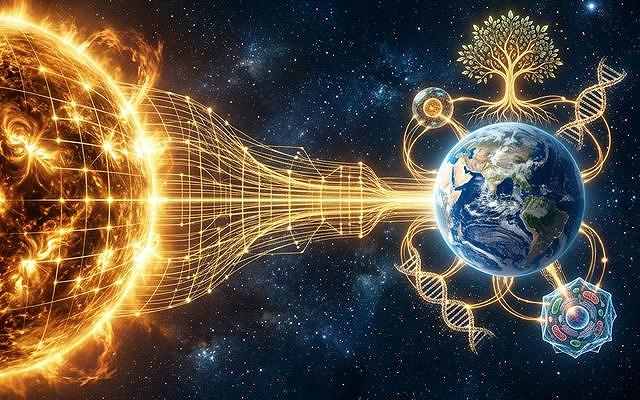
Source and Channel
There is a simple engineering principle here. It is rarely stated out loud, but it is worth stating.
If there is a powerful source of energy, but no way to transmit that energy, deliver it, make it available, then the source is useless. It simply heats itself in the void.
If there is a channel, a perfect conductor, but nothing behind it, that is useless too. Silence. An empty wire.
Complexity, life, and work appear only where two things meet: there is a source, and there is a stable channel through which that source can give itself to the outside world.
Armor / Important:
When I say “channel,” I do not mean a literal wire or fiber-optic cable. It is an image. A way of saying that there is a single flow connecting the center to everything around it. And that flow does not break, glitch, or change its rules without warning. It is something you can rely on.
01—What a “Shared Channel” Means in Plain Language
When people hear the word “bus,” they often imagine some kind of wire or cable. But a bus is not really about hardware. It is about a rule.
A bus is a way of organizing communication so that the same thing is available to everyone at once, and works predictably.
In a computer, a bus is the pathway along which signals run to multiple parts of the system. The processor, memory, and hard drive all sit on the same bus, and because of that, they can function as a single whole.
In a city, the road network acts as this bus. It connects districts so the city can be a city, rather than a cluster of separate villages that know nothing about one another.
Where there is no shared channel, there are islands. Each is on its own.
Now look at a ray of sunlight. No poetry—just the facts.
It reaches Earth every day. Regularly. Powerfully. Without warning and without delay. It arrives for everyone at once—for the stone in the desert, the leaf in the forest, and the eye looking up at the sky.
Armor / Important:
At that point, it is no longer just “shining.” It is functioning as a shared channel. Not because I decided to call it that, but because the essential condition is in fact met: there is a single flow received by everyone within reach.
02—Day and Night as a Change of Mode
We are used to saying that daytime is light and nighttime is dark, as if this were simply about our own convenience—whether we can see or not.
But if you stop looking at it through the eyes, and instead look from the side where the flow enters the system, the picture changes.
Day is when the channel is fully open. The energy flow is at its maximum. Everything that can catch it, catches it. Everything that can work, works.
Night is when the flow drops sharply. It does not switch off entirely, but it weakens. And everything tied to that flow is forced to reconfigure itself.
This is not poetry. It is just a description of what happens every day on a planet rotating around its source.
Even if you remove life and leave only rocks, water, and air, the switching still works.
During the day, the Sun heats the surface. The surface heats the air. The air rises, moves, and creates wind. At night, the heating stops, the air cools, and the pattern of the winds changes.
Water evaporates faster by day and condenses differently at night. Everything breathes in that rhythm.
And life went even further. It did not merely submit to this switching; it built it into itself. It wrote an entire library of processes on top of this simple mechanism.
Activity and sleep. Hunting and rest. Growth by day, recovery by night. Photosynthesis—and a pause when there is no light.
Armor / Important:
Not because nature loves beauty. But because it is advantageous. Because that is how the input signal is structured. And any system that wants to live inside that signal learns to adapt to it. There is no other option.
03—Connection Is Not an Add-On; It Is the Foundation
In ordinary, everyday thinking, we often imagine things this way: first there are things, and then, if necessary, we establish connections between them. Things are primary; connection is secondary.
In complex systems, it is the other way around.
Without connection, things remain just things—separate, scattered, incapable of anything large. Connection is what turns them into a system.
Here is an example to make that clearer.
Imagine a huge data center. The best servers in the world, the newest drives, vast memory, enormous computing power. But if that center has no stable connection to the outside world, it is useless. It exists, but it may as well not. No one can connect to it. No one can receive data from it. No one will even know it is running. Without a channel, that data center is just a very expensive warehouse full of hardware.
Beautiful isolation.
Now let us return to the Sun.
It may be as powerful as you like: a thermonuclear reactor, billions of years of operation, colossal energy. But if its radiation reached Earth unstably—in flashes, in bursts, with huge pauses—nothing would come of it.
Life could not arise. It needs rhythm. It needs to know that tomorrow there will be day, just as there is day today. It needs predictability in order to build long chains: to be born, to grow, to reproduce, to die.
Armor / Important:
It is precisely a stable, reliable channel that allows even the smallest, weakest nodes to do complex things.
What can a cell do on its own? Almost nothing. But when light falls on it regularly, when there is a predictable rhythm, it learns to catch that light, turn it into energy, and build itself out of that energy. A bacterium, a leaf, an eye—all of these are weak nodes. But they sit on top of a powerful channel. And because of that, they can do things no supercomputer can do.
04—Light as a Shared Channel Without Wires
If we set philosophy aside and look only at the facts, here is what we see.
In nature, there is no way to run wires. You cannot connect Earth to the Sun with a cable. You cannot distribute energy through pipes.
But light is a way of transmitting both energy and signal across distance without any wires at all. Simply through empty space.
This method has several important properties.
It fills everything around it. There is no need to aim at each receiver separately—light pours out in all directions at once, and whatever can receive it, receives it.
It does not choose whom to shine on. It shines on everyone: stone, tree, eye, water. Whatever knows how to respond, responds.
It is universal. It does not matter what the receiver is made of. What matters is whether it can interact with the radiation—absorb it, reflect it, heat up, trigger reactions.
Armor / Important:
Light is the simplest, most economical way nature has found to connect the center to everything around it. One source—and countless receivers. No wires, no complex addressing, no configuration. It simply pours outward, and that is enough.
05—Fiber Optics as a Hint
There is one thing worth inserting here. Carefully, without overreaching.
We humans have long used light to transmit information. Fiber optics is simply a glass thread through which photons run carrying data. In essence, the entire internet rests on this. Fiber optics is our human “crutch.” We realized that light is an ideal carrier of information, but so far we know how to drive it only through closed glass tubes. Nature does the same thing in open space, broadcasting at once to billions of receivers.
I am not saying the Sun is a giant fiber-optic cable. That would be absurd.
But the very fact that light can be used as a carrier, as a bearer of information, is not fantasy. It is engineering reality. We have learned to modulate light, change its parameters, and make it carry meaning.
Armor / Important:
Light is built in such a way that it can be not only energy, but structure. Frequency, polarization, phase—all of these can be changed, and those changes can be read.
We do this on our own small scale. Not because we are geniuses, but because light really is built that way.
Armor / Important:
The idea that light can serve as a communication channel does not require belief in miracles. It is already written into our technology. I am simply looking at the same principle on the scale that surrounds us.
06—What It Feels Like, Without Getting Lost in the Jargon
So as not to get tangled in words like “bus” and “channel,” let us just remember what we feel every morning.
You open your eyes. Dawn is breaking outside.
And the world around you begins to change. Not metaphorically, but in the most literal sense.
The temperature begins to rise, the air starts to move, the sounds become different. Your body feels it too—hormones shift, the brain wakes up, attention sharpens.
You call this “morning has come.” But the system you live inside reads it as a signal: the incoming flow has increased; it is time to speed up, time to work.
At night, the reverse happens. The flow drops. Activity gives way to sleep. Many processes move into maintenance, into recovery. A kind of economy mode.
Armor / Important:
That is what this channel does. It does not merely carry energy. It sets the rhythm. The rhythm of availability. The rhythm of life.
Armor / Important:
I am not saying the Sun thinks about us or sends us letters. I am saying something simpler: light arrives regularly. And everything that lives under it learns to live by that schedule. That is what this “bus” is—not a piece of hardware, but a regime.
07—Transition to the Next Scene
After all this talk about channel and rhythm, the next question naturally arises. Not about generalities now, but about what all this is actually made of.
What exactly in the flow of light can be called structure? If this is a channel, if something is being transmitted through it, then what counts as the “signal” within it? Not in the sense of a message, but in the sense of a physical quantity that can be measured and distinguished.
Light is not just a uniform flow. It has frequency—and we see different colors. It has polarization—and bees navigate by it even when the Sun itself is not visible. It has phase, intensity, direction.
All of these are parameters. They contain distinctions. And distinctions are already information in the simplest, physical sense.
And the question is how life and inanimate nature learned to use those distinctions. How the simple binary of “there is light / there is no light” grew into an entire world of colors, shadows, rhythms, and navigation.
Armor / Important:
“A ray is not just illumination, but a shared channel that opens and closes access to the flow each day; on that channel are built rhythms, cycles, and the very possibility of complex life.”
Next: What light carries within itself. Frequency, polarization, phase—and why this is not just physics, but a language in which the world speaks to us.