We are used to the schoolbook picture. Gravity is an invisible rope that lets massive bodies pull on one another through empty space. The Sun pulls the Earth, the Earth pulls the apple, and everything hangs together on those invisible threads. It is a convenient everyday model. Simple, intuitive, and good enough for practical calculations.
But it hides the real architecture of the process. The one that goes much deeper.
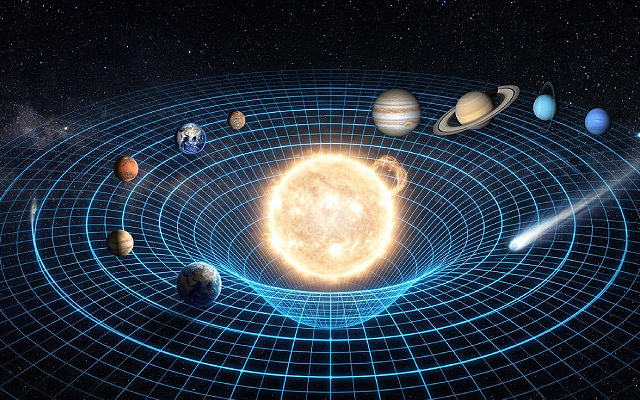
If the goal is to understand how the System governs entire galaxies, keeps planets in orbit for billions of years, and makes apples fall from branches, then the naive picture of an “invisible rope” pulling bodies toward one another has to go. Gravity has to be seen differently. As a basic routing protocol—not for data, but for spacetime itself.
01—Safety Catch
Armor / Important:
This does not invalidate classical Newtonian physics. It works, it is accurate, and no one is forbidding you to use the word “attraction” in everyday speech. The point is simply to switch lenses. To move to the description of gravity that works at larger scales—General Relativity. In that framework, gravity is not a mechanical cable, not a rope pulling one body toward another. It is geometry. Mass does not pull. Mass bends the stage on which events unfold.
02—Marking Up Spacetime
Imagine an empty stage in some 3D editor. It has a base coordinate grid. Invisible, but rigidly defined. The system uses that grid to determine what counts as “far” and “near,” where “earlier” is and where “later” is. These are the rules of distance and time.
Gravity is the fundamental module that works directly with that stage itself. Not with the objects inside it, but with the substrate—with its underlying markup.
Any massive object—a star, a planet, a stone—does not simply exist inside space. It physically deforms the coordinate grid around itself. It rewrites the rules locally. Where mass is present, the grid bends, compresses, and stretches. The metric—the way distance and time are measured—changes.
Gravity does not pull objects toward one another. It changes the stage they are standing on. Objects simply move along the grid they have been given. Along the path of least resistance. Along a straight line in curved space.
03—What It Means to Move “Straight”
If the coordinate grid of the stage has been warped by the weight of a star, then the very meaning of “the straightest possible path” changes with it. A straight line on a flat sheet of paper is one thing. A straight line on the curved surface of a ball is something else entirely.
In physics, this ideal straight route through curved space is called a geodesic. It sounds technical, but the idea is simple: it is the most natural, most direct path an object can take in a given geometry.
And this is where the most beautiful and most important shift in understanding happens.
The Earth’s orbit around the Sun is not the result of the Sun holding the Earth on an invisible leash. Not because some force keeps pulling the Earth and stops it from flying away. No. The Earth is moving freely along its geodesic through the curved spacetime around the Sun. From the outside, that looks like an orbit.
A falling apple follows the very same principle. Once it breaks from the branch, it does not fall because the Earth is pulling it. It is simply moving along its natural, most direct route through the local geometry of space. The moment it leaves the branch, the apple enters free fall—natural motion through the local geometry around the Earth.
Gravity does not shove an object from behind. It does not apply a force that drags a body somewhere. It works like a routing algorithm. It lays out the geometry of the path. It defines the grid that motion can follow. And a free body simply slides along that grid. Along the path of least resistance. Along a straight line, no matter how curved it may look from the outside.
And here is the crucial point. We do not feel the “force of gravity” during free fall. When the apple is falling, it feels no force at all. It is simply moving. We feel weight at the exact moment something prevents us from following that straight geodesic path. When the floor, the ground, the chair—the support—blocks the route. The floor is our personal “anti-geodesic” barrier. It prevents us from falling where curved geometry is trying to take us. And we experience that as weight. As pressure. As the force pressing us against the ground.
04—How a Planet Emerges from Chaos
Gravity works as a perfect amplifier of irregularities. If something in a cosmic cloud happens to be slightly denser, slightly more massive than the surrounding background, the process begins.
Picture an enormous cloud of gas and dust suspended in emptiness. In one region, the density is just a little higher than elsewhere. That region bends space around itself more strongly. And once space is curved, it becomes geometrically “advantageous” for nearby particles to slide toward it. Like falling into a pit. That is how a gravitational well appears. A well that starts gathering more and more matter around itself.
But there is one critical nuance. Gravity alone is not enough to build a dense planet. And here is why.
If particles simply fall into the well under the influence of curved space, they gain speed. They rush toward the center. And in most cases, they overshoot it. They fly straight through, pass by, emerge on the other side. Or remain in orbit around the center. The result is a swarm. Endless motion that never settles. But not a planet.
For matter to stick together into a dense body, the system needs a braking mechanism. In physics, this is called dissipation.
Particles have to collide. Rub against one another. Slow down. Heat up from those collisions. And radiate away the excess energy—the very energy that makes them move too fast—in the form of light and heat. They have to dump it into open space.
Only after shedding that excess speed, only after losing energy, can matter finally settle. Fall to the bottom of the gravitational well. Gather into a dense sphere. Become a planet.
Without dissipation, the world would remain a swarm forever. A swarm of endlessly orbiting particles that never combine into anything larger. Orbits, orbits, orbits. But not a single solid body.
05—The Event Horizon
There are places where this routing protocol enters an extreme, limit-state regime. Places where gravity, which under ordinary conditions simply defines the geometry of space, stops being a quiet force. Those places are black holes.
Mass is packed so densely there that the curvature of space becomes critical. Not just a dent, but an abyss. The routes—the geodesics objects follow—are twisted so violently that every possible path “forward” leads only inward. To the center. There is no outward route at all.
Not even light. The fastest thing in the universe cannot chart a path back out. It falls inward like everything else.
This is where the event horizon appears. An imaginary sphere around a black hole. A boundary beyond which the rules of the game change irreversibly.
Armor / Important:
What matters here is dropping the usual frightening imagery. A black hole is not a cosmic vacuum cleaner greedily sucking in galaxies. And it is not a hole in the fabric of existence that lets you fall into another world.
In systems terms, within the architecture under discussion, the event horizon is a strict access-control list. The hardest security policy possible. It is an absolute informational boundary.
From the outside, observers can still learn a few things about a black hole. Its mass, its spin, its charge. The basic parameters of the node. But any exchange of events with the interior volume works in one direction only. Data, matter, light—all of it may go in. That is allowed. But the reverse path is blocked at the hardware level. In the classical description, the engine—the quantum layer of reality—does not allow any signal to come back out once the horizon has been crossed.
06—The Stage’s Base Logic
Gravity is not just one more force among others. Gravity works with the “stage” itself—spacetime—while the other interactions work with the objects on it.
It makes orbits possible, governs the assembly of giant structures from dust, and even creates different “rates of time flow” at different nodes of the system. Compare two clocks, and the deeper one sits in a gravitational well, the more slowly its seconds tick relative to an outside observer. The engine is literally processing that state at a different frequency.
07—Why Planets Are Round
From everything examined so far about gravity—how it curves space and lays out routes—one important conclusion follows. Gravity is not just one force among others. It is a rule of space itself. The thing that determines which trajectories are possible at all and which are not.
And that leads to the next logical question. A question people rarely ask, but one that follows inevitably from the whole discussion.
Why does space around massive bodies—why do planets and stars, why does everything—tend toward a spherical shape? Why not an infinite plane, or a cube, or something more exotic?
Why is the Earth not flat, but round?
Physics has a direct answer. Once a body becomes massive enough, its own gravity starts pulling matter toward hydrostatic equilibrium. And the most natural shape of that equilibrium is an almost perfect sphere. Not because someone “chose a ball,” but because self-gravitating matter minimizes pressure imbalances and potential energy that way.
But through the engineering lens of a simulation, an interesting second layer appears. A sphere is also architecturally convenient: it has no edge, it has a natural horizon, it has no special boundary exceptions. This is not proof of “artificial creation.” It is just one of those rare cases where the physically natural solution also looks like excellent engineering.
If a stable, efficient world architecture were being designed from scratch—not in a mystical sense, but in the most literal one, as the search for the best solution under constraints—then a sphere would be close to inevitable. This is not aesthetics. It is engineering.
A plane looks simpler on paper. Drawing a straight line running off into infinity is easy. But in reality, in a working system, a plane becomes a permanent source of problems. A generator of patches and hacks needed just to keep it functioning. A sphere, by contrast, is simple and robust. It eliminates an entire class of complications in one architectural move.
No Boundary Means No “Edge of the World” Problems
Imagine that the Earth were not a sphere, but an enormous flat expanse. What follows?
If the expanse is infinite, a problem appears immediately. No real system—whether a physical world or a computer program—can operate with infinity. Infinity cannot be fully computed, cannot be stored in memory, cannot be made reliable without failure modes. The world would have to be streamed in piece by piece as motion unfolds, while hiding the fact that nothing exists farther out. But sooner or later the question arises: what is beyond the horizon? And what happens when someone gets there?
If the plane is finite instead, then it has an edge. And an edge is a separate problem. It demands special rules. Where does the ocean go when it reaches the drop-off? How does the wind behave there? What happens to a person who reaches the boundary of the world? Can it be crossed? And if not, what stops them—an invisible wall? Or a void they fall into? Every such case is an exception. It has to be invented, specified, tested. That is a weak point in any system, especially one that contains life.
A Sphere Removes That Entire Class of Problems
A sphere has no edge. No outside face. No boundary where something suddenly begins or ends. You can keep moving forward as long as you like, and eventually return to the same point from the other side.
For a world, for the architecture of reality, that means several important things.
No edge means no need to invent what lies beyond it. No infinity means everything can be computed, measured, and held within bounds. Energy, mass, surface area, atmosphere—all of these become finite quantities. They can be worked with, understood, and relied on.
The world remains predictable. Manageable.
In the simplest and most precise sense, a sphere is a space without exceptions. No special places where the rules suddenly stop working or require extra explanation. Everything is unified. Everything is closed. Everything works the same everywhere.
Gravity Requires a Physical Source for the Field
A flat world with gravity runs into a problem. If people are supposed to “just stand on the ground,” then “down” has to be defined as a universal rule for the whole world. Say gravity always points strictly downward along one straight line, the same everywhere.
But where does that infinite, uniform field come from? What is its source?
A flat model has to introduce extra artificial assumptions about how that gravitational field is generated and what keeps the world internally consistent. In that sense, it looks less natural than the spherical model. And if the plane is finite, a second problem appears: gravity should weaken near the edges—there is less mass beneath your feet there—which conflicts with the desire for the same gravity everywhere.
So the only option is to insert a rule that says: “gravity exists because it has to.” That works in games. In the real world, that is magic. It breaks physical self-consistency.
A sphere solves the problem cleanly and rigorously. At every point on Earth, gravity points toward the center. Toward the center of mass.
Wherever a person happens to be, “down” is defined locally. And the rule works the same everywhere. The ocean and the atmosphere hold themselves in place simply because they are pulled toward the center. No special logic has to be invented for an edge, because there is no edge.
That is the basic protocol. One formula for every point in space. One rule that works everywhere in the same way.
The Horizon as a Natural Limiter
A flat world has another problem: how distant objects are seen. If the surface is infinite, then any object, no matter how far away, should always remain visible. It would just get smaller and smaller until it turned into a dot. But it would never disappear.
For any working system, that is a disaster. The engine—whether a program or reality itself—would have to compute infinite distance. Or introduce artificial fog to hide that infinity.
A sphere solves this on its own. It has a natural horizon. Objects disappear behind the curvature of the surface automatically. A ship sails away, gets smaller, and then simply vanishes beyond the horizon line.
What does that mean for the architecture of the world?
Distant objects do not have to be rendered—they leave the field of view on their own. The far world is clipped by geometry. It is a built-in filter: you see exactly what lies within line of sight. And exactly as much of it as needed.
From the system-design perspective, a sphere is a perfect optimizer. A ship disappears beyond the horizon not because someone decided to hide it, but because the geometry of space physically blocks the line of sight. That is how space itself is built.
Day and night work by the same principle. There is one light source—the Sun. And there is the rotating sphere of the Earth. At any given moment, exactly half the surface is lit and half is in shadow. Not because it was “designed that way,” but because this is the only possible geometry for a sphere illuminated by a single source.
08—Meta-Conclusion
Gravity is not a “force” that pulls one body toward another. It is a rule of space that determines which trajectories are possible and which are not.
If that is true, then the globe, the geoid, the sphere is not just “the shape of a planet.” It is the shape space itself takes when it obeys that rule.
Seen as a system—in an engineering sense, not a mystical one—the sphere becomes the choice an architect makes if the goal is:
- for physics to work the same way at every point,
- for the world to have no edge beyond which the unknown begins,
- for horizons and distances to require no artificial tricks,
- for light and shadow to be honest consequences of how the world is built, not staged effects.
For a large self-gravitating body, a sphere is close to the minimal and most natural equilibrium form.
That is why the world feels “natural.” Not because someone decided it should. But because it is assembled not from patches and exceptions, but from one correctly chosen foundational rule.
Next: But if gravity is the curvature of space, then what is space itself? An empty box that things sit inside, or something far more complex? Next comes the concept of the physical vacuum and quantum fields.