In the previous chapter, we arrived at the idea that the human body is a brilliantly engineered biological avatar. An extraordinarily complex mechanism assembled from water, carbon, and a few dozen chemical elements. But if it is only a sophisticated suit, then one question follows naturally from everything we have discussed so far.
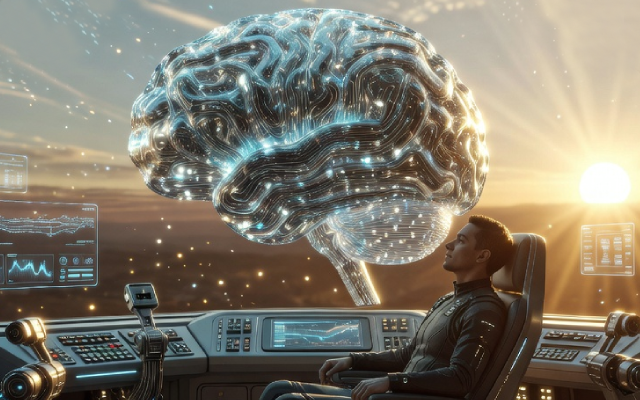
Who controls it when we are not thinking about it?
We breathe. Tens of thousands of breaths a day. We do not issue a command for each one. The lungs work on their own. The heart beats. Thump-thump, thump-thump. We do not know how it is built, we do not control its rhythm, and yet it keeps beating for decades without stopping. We digest food without thinking about which enzymes to release or how much bile to send into the intestine. We pull a hand away from a hot stove before we even fully realize we have been burned. We drive along a familiar road and suddenly notice that we do not remember the last three minutes—and yet the body was driving, turning, braking, and responding to traffic lights the entire time.
Who is running all of that? Where is the pilot? Where is the little operator inside the skull pulling the levers?
If you scan a human being, you will not find some magical department inside. No cockpit where a pilot sits with a cup of coffee, watching the instruments. All you will find is biological hardware. Neurons, synapses, electrical impulses, chemical signals. Protocols. You will not find a separate chamber where a finished self sits like a tiny manager.
01—Safety Catch
Armor / Important:
I am not arguing with classical neurobiology. It describes the brain with remarkable accuracy—how neurons exchange signals, how connections form, which regions are responsible for speech, which for vision. All of that is true. That is the hardware and the protocols.
But even very precise neurobiology does not fully close the question that interests me: how a mechanism becomes an experienced “I.” The question is: who exactly makes the decisions? Where is the boundary between the equipment and whatever uses that equipment?
For the system to work without magic, two things need to be clearly separated. The hardware infrastructure—the brain, neurons, electrical circuits. And the user session—consciousness, the very process that arises when the hardware operates in a certain way. One is the terminal. The other is the process running on that terminal. Like a computer and a program. The computer can be touched. The program is simply code running on it.
02—What the Scanner Sees
If you look at a human being only through instruments—through a scanner that peers inside the skull and tracks brain activity—the picture becomes very clear. And disturbingly simple.
A human being looks like a deterministic biological machine. A highly complex one, yes, but still a mechanism operating by strict algorithm. A stimulus arrives—a reaction follows. Nothing extra.
Genes inherited from our parents set the startup configuration. They determine what the organism will be predisposed to from the beginning. Some are born with elevated anxiety, others with a low threshold for aggression, still others with a strong memory for faces. That is the base firmware.
Hormones and neurotransmitters function like system switches. They relabel events as “important” or “unimportant.” Dopamine does not command reward in the simplistic way it is often described. It tags events: “repeat this,” or “avoid this.” Cortisol and adrenaline push the system into high-alert mode. They speed up reactions, shift priorities, and mobilize resources.
Neural networks—the billions of connections between cells—function like cache memory. They store successful behavioral patterns so the system does not have to compute them from scratch every time. You learn to ride a bicycle once—and after that the body does it automatically, without conscious involvement.
From this angle, if you look only through instruments, there is no “I.” There is only a cascade of signals. Electrical impulses racing through neurons. Chemical substances amplifying or dampening those impulses. Control loops switching on and off depending on external conditions. That is all.
This picture is highly accurate at the level of mechanism. But for me it still leaves the first-person question open: how does any of this become experienced as “mine”?
It describes the mechanism. It explains how neurons work, how signals travel, how habits form. But it does not explain one crucial thing. It does not explain the addressing of subjectivity. Why is all this activity experienced as “about me”? Why does pain feel like my pain, joy like my joy, fear like my fear? Why do billions of neurons exchanging electrical signals suddenly assemble into a single “I” that reads those flashes as meaning?
The scanner records activity. But it does not record the one who lives through that activity. It does not see the reader of the data.
03—Two Modes of Control
To understand how we are actually built, we have to stop looking for a tiny commander inside the skull issuing every order. There is no such figure. What operates instead is a dual-loop architecture. Two control streams running in parallel, at the same time, but at different speeds and with different responsibilities.
The Fast Loop: Milliseconds to Seconds
This is the autonomous layer. It does not ask permission. It simply runs.
The unconscious. The base drivers of the hardware. Body temperature stays within a narrow range. The heart beats in its operating rhythm. Breathing continues—inhale, exhale. Digestion digests. The immune system fights viruses. None of this requires thought. None of it is under direct control. Most people do not even know how it works. Yet the system runs continuously, from startup to shutdown.
The subconscious. This is the autopilot. A collection of scripts built over a lifetime. The subconscious scans for threats in fractions of a second, faster than conscious awareness can register danger. It pulls a hand away from a hot stove before the event is fully noticed. It reads another person’s tone before their words have been consciously analyzed. It drives a car along a familiar route while your mind is somewhere else. It generates draft decisions in real time. Only a split second later does consciousness receive the ready-made option.
This layer handles real-time demands. Speech, movement, catching a ball, dodging an obstacle—all of it runs on autopilot. Delay is critical here. If every step had to be consciously calculated, you would never catch a flying ball or hit the brake in time.
Consciousness. This is the interface. The dashboard and the cursor of attention. Consciousness can focus on one task, hold a goal, avoid scattering itself. Most importantly, it can veto the drafts produced by the subconscious. The autopilot proposes an option. Consciousness can say: no, not that. And offer another.
But consciousness is an extremely expensive mode. It consumes enormous energy. You cannot live there continuously. If every second of life, every decision, every movement had to be fully conscious, the system would burn out. It would overload and shut down.
The Slow Loop: Hours to Days
This is the strategic layer. Instant reaction is not needed here. Something else is.
The formation of long-term priorities. What actually matters to me? Not “what do I want to eat right now,” but “who do I want to become.” Not “which book should I read today,” but “what trace do I want to leave behind.” These are not decisions that tolerate haste.
The profile of prohibitions. Deep values that determine which automatic reactions are approved and which are blocked. The autopilot may propose striking back after an insult. But if you have built a rule for yourself, you can answer: no, that is not how I act. That rule is not hardwired into biology. It is formed by the slow loop.
The integration of experience. What is lived through does not vanish. It is interpreted, processed, folded into the personality. You do not remember every single day, but every day changes you. The slow loop is responsible for that assembly.
Strategic decisions. Not “turn left or right right now,” but “which direction is worth going in at all.” Not “what food to order for lunch,” but “how do I want to live my life.”
This loop does not govern reflexes. It is too slow for that. It cannot yank a hand away from fire. But it can gradually correct the course. Tune the filters of perception. Update the value system. Change who you become over the long term.
04—Breadcrumb #1: Where Is the “I” Located?
I have now laid out the two control loops. The fast one works in milliseconds. It runs the body, the reflexes, the habits. The slow one works across hours and days. It forms values, integrates experience, and sets direction.
But then one question appears. A question the scanner cannot see and neurobiology cannot fully explain.
The fast loop operates locally. Inside the skull. Everything needed to pull a hand away from fire or catch a flying ball happens inside the brain. Neurons exchange signals, muscles contract, the body reacts. All of that can be recorded, measured, and traced.
But the slow loop—where does that run?
When you think about who you want to become in ten years, where does that reflection happen? In neurons, yes. But neurons are only cells. They transmit electrical signals. They do not feel significance. They do not experience meaning. They do not know what an “I” is.
The scanner sees activity. It sees which brain regions light up when you recall the past or plan the future. But it does not see the one who remembers. The one for whom that past is personal. The one to whom the future matters.
This is where the first-person problem appears: why do all these billions of neurons, merely transmitting signals, suddenly gather into a single “I”? Why does memory feel like my memory, pain like my pain, joy like my joy? Why does that sense not disappear during sleep? During unconsciousness? Under anesthesia?
The computational power of the brain is immense. But where does the continuity of the “I” come from? That element which remains the same even as the body ages, cells are replaced, and memory changes.
In distributed systems—in the architectural language I use here—there is a simple principle. If a task does not require instant response, if it is complex, resource-intensive, and demands large-scale storage, it gets offloaded to a remote server. The terminal—the local device—keeps only the cache and the interface.
That leads to the question I cannot let go of.
What if the slow loop—the sense of self, long-term memory, strategic planning, that ongoing feeling that I am me and that this continues through time—is not located inside the skull? What if the brain is only an interface? And at that point this is no longer science but a thought experiment. What if the brain does not exhaust the entire process of selfhood, but functions instead as the local interface of a wider loop?
It is only a question. No answer yet. But it hangs in the air.
05—Why Most of Life Runs on Autopilot
You get into the car after a brutal workday. Your mind is busy with a project due tomorrow. You turn over options in your head, argue with an invisible opponent, hunt for a solution. Then, half an hour later, a sudden realization: you are already parked at home. You do not remember leaving the lot, shifting gears, or stopping at red lights. The body drove while your mind was somewhere else entirely.
Everyone knows this state. And it should not be frightening.
While the user session—that consciousness we usually identify as ourselves—was occupied with abstract thought, the local controller took over. The subconscious. The autopilot. It delivered the avatar to its destination flawlessly, without asking permission and without demanding involvement.
There is nothing alarming about that. “Autopilot” does not mean you are fake. It means the system you are embedded in is brilliantly optimized.
Take any serious technical system. A car. An airplane. A factory line. Manual mode is used only in special situations. When something unusual happens. When a new and unfamiliar task appears. The rest of the time, the system runs automatically. That is not a bug. It is a remarkable feature. It is the only way to operate efficiently without burning out from overload.
The same is true of the body and the brain.
Most of the time—walking, breathing, eating, driving along a familiar route, carrying out routine work—we operate on autopilot. Consciousness is free in those moments. It can think about something else, dream, plan, revisit the past. That is normal. It does not turn us into robots or hollow characters.
Because one crucial difference remains.
The autopilot is not the whole system. It is the lower layer—efficient, fast, energy-saving. But we still have the capacity to step out of the script. Consciousness can seize control at any moment. It can say: no, now I take over. I choose. I decide otherwise than habit.
That is the difference between an advanced NPC in a video game and a living agent. An NPC never leaves the script. It does only what its code allows. A human being can. Not always, not at every moment, but the capacity is there. We can notice automatic behavior, stop, and act differently. That exit from automatism is one of the most human things in us.
06—The Radio Receiver Error
This is where the central mistake of modern science is born. The one that fuels the fiercest arguments. The one that leads many people to conclude that they are nothing but biological machines with no free will.
The mistake sounds like this: “We cut open the brain and did not find free will inside, therefore free will does not exist.”
It sounds persuasive. But it is an addressing error. An error of descriptive level. An error about where exactly the answer is being sought.
Armor / Important:
Imagine an engineer who has never heard music. A radio receiver is placed in front of him. He disassembles it screw by screw. Inside he finds wires, transistors, magnets, a speaker. He checks everything. Studies every part. And nowhere inside does he find a tiny singer. No little performer sitting in the box.
The bad conclusion: “Music does not exist. What you call music is only membrane vibration. There is no source, no meaning.”
The accurate conclusion: The property called “music” does not have to reside inside any single part. It emerges at the level of the whole system. The source of the sound is somewhere far away, in a studio. The channel—radio waves—carries the signal. The receiver catches and decodes it. The speaker turns electrical signals into vibrations in the air. The music is real. It just is not inside the radio receiver.
I use this analogy not as proof, but as a way of separating the receiving device from the question of source and the experience of signal.
The brain is a powerful local processor. It calculates probabilities in milliseconds. It generates action options: “hit,” “run,” “eat,” “speak.” It is brilliant at real-time tasks. It keeps the body balanced, reacts to threats, controls speech. All of that is its job.
But control, consciousness, that very “I” which reads the drafts of the autopilot and can say “no,” is a higher-order mode. It does not have to sit in one neuron or one region of the brain. It emerges at the level of the whole system.
Where exactly is it located? In the brain? Partly. In the body? Partly. In feedback from the world? Partly. In language and culture, which shape our decisions before we consciously notice them? Partly. This is a distributed loop. It does not reduce to a single local component.
Not necessarily “outside the brain” as some mystical entity. But not reducible either to a single local trigger that can be cut out with a scalpel and placed on a table.
07—Breadcrumb #2: Where Is the Control Node?
In my model, I want to introduce a hypothesis. It may sound strange, but it follows logically from everything I have laid out so far.
The strategic loop—the one I discussed earlier—may not be exhausted by the brain’s local neural machinery. This node does not govern reflexes—that is the job of the fast local loop. It governs long-term policy: who you are, what values you hold, and what vector of motion unfolds across years.
At that point a physical problem of causality appears. If the node governing the slow loop is located at a distance, the signal must arrive with delay. It physically cannot control fast movements in time—pulling a hand away from fire or catching a ball. But that is not a contradiction. It actually explains why the remote node does not interfere with reflexes. It works only in the slow loop, where instant response is unnecessary.
Bandwidth can be increased—you can transmit more data at once. But latency cannot be eliminated. A signal travels at finite speed, and response time remains bounded. That is why a remote node cannot steer reflexes or rapid movement. It can operate only in the slow loop. Policy, values, integration of experience. Things that do not require immediate response.
How could that work? Through the dual-loop architecture I have already described. The fast loop is local, inside the body. The slow loop is distributed. I will return to this paradox later and unpack it through an analogy familiar to every gamer.
The Classic Objection
A skeptic following this line of thought may say: “All of this is elegant, but there is one problem. Radio waves can be measured outside the receiver. Your ‘signal of consciousness’ cannot. So the analogy fails.”
That is a fair objection. And right now it is the most vulnerable point in my model.
If the channel is physical, it should produce measurable effects. If there is a transmitter, a receiver, and a signal traveling between them, then instruments should be able to detect it. At present we have no instruments capable of directly registering such a signal. So this is not an established fact. It is a working hypothesis. A direction for testing. The radio receiver in my analogy is a metaphor used to separate source, channel, and terminal. It is not a technical blueprint of the mechanism.
08—Freedom as an Interrupt
If you strip away the metaphors, then the self is a biological machine for as long as it rides the rails of habit. A hormone pushes—I act. The autopilot proposes—I agree. A reflex fires—I react. In that mode there is no room for doubt, no room for choice. There is only a chain of cause and effect.
But free will does appear. Not as a constant property. Not as something switched on all the time. It appears at one specific moment.
In computer systems this is called a hardware interrupt. The system is running its algorithm, executing the script, staying on course. Then an outside signal arrives. The system stops, shifts attention, processes what came in, and either returns to the previous scenario or moves into a new mode.
Something similar happens in human life.
Imagine being harshly insulted. In words or in action. The local autopilot responds instantly. It does not ask permission. Heart rate spikes. Adrenaline enters the bloodstream. Muscles tense. And a ready-made script appears: “Hit back. At least shout. Defend yourself. Do not allow humiliation.”
All of that happens in fractions of a second. Faster than conscious awareness can keep up.
And then, right there at the boundary, a gap appears.
You feel the anger. You recognize the impulse. The body is already prepared to act. The autopilot has already proposed an option. And inside that gap, a choice becomes possible.
Hit. Shout. Stay silent. Answer calmly even while everything inside is boiling. Turn around and walk away.
You have not killed the autopilot. It has not vanished. It keeps working, keeps proposing options, keeps generating impulses. But you have inserted yourself into the process. The local system raised the alarm, marked the event as critical, requested attention. And consciousness—that distributed control loop—pressed stop. It applied a veto. It selected a different path. Not the default option, but another one.
That is freedom. Not a permanent state, but a rare, expensive, energy-intensive interruption. A moment when you step out of the script.
09—Breadcrumb #3: Who Pressed Stop?
Earlier I said that consciousness can press stop and apply a veto. It can interrupt an automatic reaction and choose another option.
And that immediately raises a critical question. The question anyone committed to a hard scientific worldview will ask.
But who pressed that veto? Who decided to press stop? Maybe that too was just another automatic process. Maybe it was only a different section of the neural network firing a little later, but still according to a prewritten algorithm.
It is a good question. The most honest one of all.
From the scanner’s point of view—from the perspective of an outside observer looking at the brain from the outside—that may indeed be all it is: a chain of neurons. One region activates, then another, then a third. Electrical impulses run their routes. Nothing more.
But from the first-person perspective—from the perspective of the one inside—I experience that moment differently. I feel it as a real choice. As the instant when one option was possible, yet another was taken. And that experience is real. It is not fabricated. It is directly available to me, without instruments, without intermediaries.
And here a fork appears.
Either we accept subjective experience as valid data—data that belongs in the picture of reality even if the scanner cannot see it. Or we declare all inner life an illusion. We say: no, you do not really feel this, it only seems that way. There is no choice, only a chain of causes and effects.
But if we take that second path, we lose the observer. The one who runs experiments. The one who interprets data. The one who writes scientific papers. If consciousness is only an illusion, an epiphenomenon, a side effect of neuronal activity with no real causal force, then who is doing science? Who decides which hypothesis is true and which is false?
First-person phenomenology is the only data directly available to us. Everything else reaches us through it. Through sensation, perception, experience. To dismiss it as unreal is to dismiss the very possibility of knowing anything at all.
10—How the Veto Works
At the level of neurophysiology—the very level the scanner sees and scientists study—the veto is implemented by local inhibitory circuits in the brain. That is a scientific fact. The brain contains neurons whose job is not to activate an action, but to suppress it. There are circuits that block impulses that should not pass. All of this can be observed, measured, and described.
But within my model, the experience itself—“I could have acted differently; I did not choose the option the autopilot proposed”—is treated not as an illusion, but as the work of a higher-order control layer. The slow loop I described earlier.
This loop does not interfere with reflexes—that is the job of the fast layer—but it does adjust long-term policy. It tunes the profile of prohibitions: which automatic reactions are allowed through and which are blocked.
The important point is that this process does not require instant response. The fast loop reacts in fractions of a second. The slow one can think in minutes, hours, and days.
You can make a mistake, strike back after an insult, and regret it an hour later. That experience—regret and recognition—enters the database. Next time the autopilot may propose the same impulse, but the profile of prohibitions will already be different.
The brain proposes a scenario instantly. But the final correction of policy happens later, in the background. A ship cannot change course through one sudden jerk, but it can gradually turn, step by step.
11—Terminal Sensitivity
If we are asking how the terminal—our body and brain—might register extremely weak signals from the surrounding environment, we have to distinguish two levels. Two scales.
The first is local. What happens inside the skull.
There are hypotheses here that remain highly controversial. The best known is the Penrose-Hameroff hypothesis. It proposes that quantum effects may play a role in the microstructures of neurons—in the tiny tubules inside cells. Consciousness, in that view, may be connected not to neurons as whole units, but to quantum processes taking place within intracellular structures.
It is important to be clear: even if that were true, it would not be an interplanetary modem. It would not be a way of talking to the stars faster than light. It would be a local sensitivity amplifier. A mechanism allowing the terminal to register extremely weak changes in the environment. Changes too subtle for classical, “coarse-grained” detectors to catch.
But let’s be honest. This is a disputed hypothesis. Strong criticism exists. The central argument is that in the warm, wet environment of the brain, quantum effects should decohere almost instantly. Decoherence—the process we discussed in the chapter on quantum physics—happens too quickly. It is difficult to imagine how a quantum state could remain intact long enough to influence neuronal function.
I am not presenting this as a proven mechanism. I am using it as a possible image of a local trigger. One hypothesis among others that might explain why the terminal is sensitive to things classical physics does not register. But not an established fact.
12—The Tuning Fork of Selfhood
A subtle but critical boundary has to be fixed here. Otherwise my model collapses into magic.
I do not imagine this as the transmission of messages or thoughts. It is closer to a possible synchronization of state—like two tuning forks that do not exchange commands, but can maintain a shared tuning.
That would mean a person and something else exist as parts of one common state. In that case they could display instant correlation without transmitting controllable information faster than light.
To avoid the trap of “magical Wi-Fi,” I separate two things.
The telegraph is what I reject.
That is the idea that something sends a signal in bits and the brain receives and decodes it as a command. It sounds elegant. It feels like science fiction. But it immediately triggers the right objection: how does that fit with causality? How does information travel faster than light? No—such a telegraph is impossible.
The tuning fork is what I am proposing.
In that picture, the brain and whatever this other node is are linked not as sender and receiver, but as nodes of a shared quantum layer. If so, then:
No “text” of thought is transmitted. There is no message to read and understand.
What is maintained is synchronization. A shared tuning, a shared “phase,” a common key of presence.
The metaphor is two tuning forks. One does not “command” the other what melody to play. But they can maintain a common tuning. A phase match, a resonance. Strike one—and the other begins to vibrate in the same key even though no wire connects them.
And here I take the next step. A step that sounds strange, but follows logically from everything that came before.
If consciousness is not a product of the brain, but a process running somewhere else, while the brain is only the terminal receiving and displaying the signal, then where could the source of that signal be?
In my model, I assume that the strategic control node—the slow loop—may be connected to the main source of energy and rhythm in our system. The Sun. Not in the sense that the Sun is a computer calculating our thoughts.
But in the sense that the Sun is the primary anchor of the stage. The most powerful, stable, long-duration object in our local environment. It sets the rhythm, supplies the energy, shapes the heliosphere—the protective domain within which life exists.
If I am going to look for an external anchor element in this model, the Sun presents itself as a candidate. Not as a mystical center of selfhood, but as the most stable physical generator of rhythm in our environment.
What would that explain?
The continuity of presence. The sense of “I am” as a background condition that does not depend on daylight. Even in total darkness, even with closed eyes, you still feel that you exist. That does not require sunlight, but it may require connection to a node that never switches off.
The stability of identity. The feeling that the session does not break. You fall asleep—and the “I” does not vanish. You wake up—and it is still you. Memory can fail, the body can age, everything can change—yet the sense of “this is me” remains. As if the continuity of selfhood rested on more than the brain’s local memory alone.
The possibility of gentle adjustment. Not a top-down command. Not an order from above. But a reweighting of options at those points where the autopilot generates several drafts. Consciousness selects which action variant to ratify. And that selection may be supported by a shared tuning with the anchor node.
Armor / Important:
This remains a hypothesis. Not a proven fact. But it is stronger than the “telegraph” model because it does not require controllable messages to travel faster than light. It uses the quantum layer not as a text channel, but as an anchor for synchronization of state. Like a tuning fork holding a common note. And if one asks which object in our system could plausibly play that role, then within this model the Sun naturally appears as one possible candidate.
Light as Telemetry, Not as the Channel of Selfhood
In my model, sunlight has an important but strictly limited role. It is not the carrier of consciousness. It does not transmit thoughts. It does not issue commands.
Light is the telemetry of the stage. It configures the operating modes of the hardware.
It regulates circadian rhythms. Light and darkness structure the hormonal cycle. Cortisol rises in the morning. Melatonin is produced in the evening. We do not sleep because someone gave an order. We sleep because darkness switched the mode.
It affects tone and mood. Light deprivation, a long winter, the absence of sunlight outside the window—and the system begins to misfire. Mood drops, energy declines, motivation fades. That is not “sadness” in some vague poetic sense. It is hardware tuning. Light therapy works precisely because light is a tuning instrument, not magic.
It affects the quality of the local loops. Attention, energy, the capacity to focus—all of that is tied to the light cycle. On a cloudy day the brain works differently than on a sunny one. Not because the thoughts are worse, but because the terminal is operating in a different mode.
Light matters. For human life, and for most life in the surface biosphere, it is critical.
But it does not have to be the carrier wave of selfhood. It does not transmit the “I” from the Sun to the brain. It tunes the receiver, but it does not broadcast the program.
13—Where the Pilot Is
A human being is born without a finished worldview, but with a powerful inborn architecture for perception and learning. Unlike insects, whose instincts are hardwired like code in a chip, we begin with very few ready-made solutions. We are not born knowing how to walk. We are not born knowing how to speak. Everything has to be learned. And that emptiness at the beginning is not a defect. It is an opening. The possibility of rewriting scripts. Changing habits. Learning new patterns. Building models of the world, and then compiling them downward into automatic action.
As I have already laid out, all our lives are built on two loops running in parallel.
The fast loop—the brain—works in real time. Milliseconds, seconds. Breathing, reflexes, habitual autopilot. It reacts to a blow, maintains balance, drives the car.
The slow loop—strategy—works across days and years. This is where the “I” forms, where the value system and the profile of prohibitions take shape. This is where experience is not merely lived through, but integrated into personality. This is where the question is not “where do I turn right now,” but “where is this life going at all?”
Freedom is not a constant state. You are not free every second. Most of the time life runs on autopilot, and that is normal. Freedom is a rare, expensive, energy-intensive mode. The capacity to notice the scenario biology is proposing and sign off on a different one. Not instantly—reflexes cannot be cheated—but strategically. By correcting long-term behavioral policy. By changing the settings. By rewriting the profile of prohibitions. By choosing who to become next.
And if someone asks, “Where is the pilot in this architecture? Where does the one who controls it all actually sit?”—my answer is this.
You do not find the pilot in the engine. You can take an engine apart down to the last screw, and you will not find the driver there. But that does not mean the car drives itself. In my view, the pilot should be sought not as a separate part, but as a level of organization of action—where automatism gives way to course correction.
14—Final Bookmark
If a slow control loop exists that does not require instant response, then three key questions follow:
- Where could this strategic loop be physically located?
- How would the connection work technically—and why does causal delay not break the system if the fast loop is local?
- What happens to consciousness when the terminal—the “radio receiver”—fails?
And one more clarifying question:
if the “channel of selfhood” is not a telegraph but a synchronization of shared state, then what exactly could play the role of anchor rhythm, how is that sustained 24/7, and why is the terminal capable of entering resonance with that anchor at all?
To answer those questions, we will have to look at the most obvious, most luminous, and most neglected object in our sky.
The object worshiped by every ancient civilization.
The object on which all life on Earth depends—but not only as a source of heat.
The object around which people have long tried to find statistical links to shifts in rhythms, health, and population mood—though this is also where overreach becomes especially tempting.
It is time to talk about the architecture of the channel.
Next: If consciousness operates through a dual-loop architecture (fast local + slow strategic), where might the strategic processor be located? What could serve as the 24/7 environment of the channel of selfhood, independent of day and night? How does telemetry (light) affect the terminal’s operating modes without replacing selfhood?