There is one strange thing. We rarely say it out loud, because it seems too obvious. So obvious that the thought stops before it even begins. We take it as a given, as a fact that does not seem to require explanation.
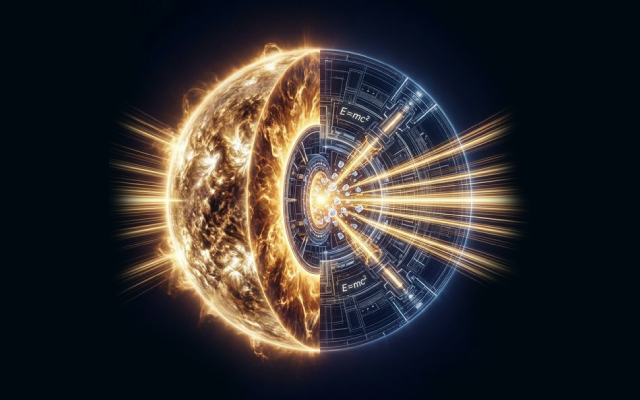
Where Exactly the Node Does Its Work
We say, “The Sun shines.” We have been saying this since childhood, without thinking about it. As if it were simply an inherent property of the object—like color or shape. As if it simply “is”—big, yellow, shining—and that is where the thought ends.
But if we have already agreed to look at the Sun as a node in a system—as the central interface that holds the gravitational framework together, sets the cadence for the entire periphery, supplies energy to every complex process, and makes the scene observable—then a question arises, and architecture is obliged to ask it.
Any “central role” in any system is never an honorary title. It is always a function. A server in a server room matters not because it is beautiful or heavy. It matters because it is continuously doing something. It is working. It maintains its operating state without shutting down for years. It converts one kind of resource into another—electricity into computing power. It distributes that converted resource as a stream of data to every connected client.
That is exactly what I am asking now when I look at the Sun. Where is the point at which the star’s internal thermonuclear work, hidden from us, becomes an external flow available to the entire periphery? Where do the depths become the interface?
01—What Would Happen If the Sun Became Passive
Sometimes, to understand the essence of a working mechanism, it helps to imagine this: what would happen if the Sun simply switched off its flow?
We already know the answer: the collapse of gradients, the halt of photosynthesis, absolute zero. This thought experiment reveals the main point: “shines” is not a passive property of an object, like color or shape. It is a verb. It is an action. It is a continuous mode sustained over billions of years. It is an energy-intensive process of maintaining the scene.
And if my model is to remain honest, if I do not want it to collapse into empty metaphor, then this is exactly where I have to look. Into the place where this mode, this process, is born. Not mystically “inside a deity,” not into poetry, but into the most rational, most physical center. Into the core, where the main event takes place.
Where thermonuclear fusion happens.
Where hydrogen becomes helium.
Where an internal resource, accumulated over billions of years, is converted into a form accessible to the external world.
Where that very outward release of energy begins, in the form of radiation—the thing we simply call “shines.”
02—Why “Compilation”
Here, I think I need to explain why I chose exactly this word for this section—“compilation.” Not because I am trying at all costs to force computer science onto physics, or pretend that all of this is really about computers. But because the word carries a very precise, almost everyday metaphor that helps illuminate the essence of the process.
Compilation, in the broadest sense, is translation. The translation of something potential, something that exists as a resource, into something working, executable. There was raw material—now there is a flow. There was code no one could see—now there is a program that can be run. That is exactly what happens in the core of a star. Internal resource, accumulated mass, potential—gets translated into an external flow of radiation. Into the thing that powers and polls the entire system.
03—E = mc² as Protocol
And now we come to what is probably the most famous formula in the history of physics. A line everyone has seen, even those who cannot stand physics. And yet almost no one except specialists has felt it as the description of a living, ongoing process.
Armor / Important:
$E = mc^2$
A dry, compact notation. Three symbols. But if you try to understand it not as an abstract equation hanging in empty space, but as the description of a protocol—as an instruction according to which the node operates—it suddenly opens up in a completely different way.
It becomes a key. An explanation of how exactly the central node in our system pays with its internal resource so that the external flow, on which the entire periphery depends, does not stop for even a second. How exactly it does this—through the mass defect in thermonuclear fusion reactions. Through the conversion of part of matter into pure energy.
Armor / Important:
Next: The Formula as Protocol. What $E = mc^2$ Means in Human Terms.