After the “interruptions” and channel noise in the previous section, a new question arises for me—an almost architectural one: if there is a Central Node and there is a communication channel, where, then, is the boundary of the whole system? Any complex architecture rests not only on power and communication, but also on domain rules. On where its own space ends and the external begins; where internal protocols still apply, and where there is only external chaos.
Safeguard
Armor / Important:
The word “protection” here is not about someone’s intention, and not about a guard standing watch. I am describing a strict hardware function that can be measured and recorded: the node creates around itself a volume of space in which its flows and its magnetic fields hardware-dominate. This is not a wall or a dome. It is a zone in which the central source sets the rules. Everything inside obeys those rules.
01 — Domains: Not a Wall, but a “Cloud of Influence”
In ordinary, everyday imagination, a boundary is always something rigid. A wall. A fence. A line you cannot cross. But in real, truly distributed systems, a boundary works differently. More often, it looks like a zone—a transitional space.
It is a zone of transition: the center’s signal is still present, but it no longer defines the system.
That is how the space around the Sun works.
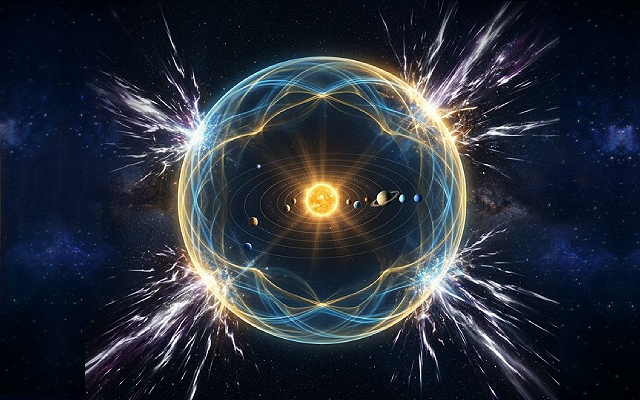
The Sun constantly, every second, throws off a stream of charged particles. We call this the solar wind. It rushes outward in all directions and inflates a vast bubble in the interstellar medium. A bubble inside which hardware-level reality is shaped by the Sun, not by what lies beyond it.
In astrophysics, that bubble has a name: the heliosphere. It is a region of enormous scale, extending far beyond the orbits of all the planets. Inside it, the solar wind and the magnetic fields associated with it define the environment. They are what dominates here.
Armor / Important:
This is not a glass dome, not armor you could touch, and not some mystical force shield from science fiction. It is a hardware-level operating zone. A zone where “our” flows—the flows from our central node—are physically stronger than the “foreign” flows arriving from the depths of the galaxy.
02 — The Boundaries of the Heliosphere
The heliosphere has a definite structure. It can be described, and that description is not speculative—it is observationally grounded. In rough terms, its layers look something like this.
First, near the Sun itself, the solar wind races outward quickly and freely. This is its native element. But the farther it travels, the weaker its pressure becomes. And at a certain, very distant frontier, it encounters resistance. The opposing pressure of interstellar gas no longer allows it to keep expanding freely.
The wind is forced to slow down. It becomes compressed, starts behaving differently—turbulently—and shifts into another regime. This zone is called the heliosheath: the braking region.
And farther out, beyond that, lies the final frontier. The point of no return. It is called the heliopause. This is the boundary beyond which the solar wind no longer has the power to dominate. There begins the full, unconditional rule of interstellar space. Foreign territory. Another domain.
Armor / Important:
And this is not just theory, not just a beautiful hypothesis. This boundary exists physically, and we have measured it. The Voyager 1 probe, launched in the late 1970s, crossed the heliopause and entered interstellar space on August 25, 2012. That happened at a distance of about 122 astronomical units from the Sun. One astronomical unit is the distance from Earth to the Sun. In other words, it was 122 times farther out than Earth’s orbit—beyond the limits of our domain. The boundary of solar influence turned out to be physically measurable. Instruments can touch it.
03 — A “Firewall,” but Not an Absolute One
In engineering—especially in network engineering—there is the concept of a firewall. A good firewall is not a blind wall. It is something that manages flow intelligently and competently. Some things it cuts off immediately because they are clearly dangerous. Some things it blocks with confidence, but lets through after inspection. Some things it holds back in order to examine and analyze them. And some things, recognized as neutral or safe, it lets pass without distortion, without interfering with movement.
The heliosphere—this enormous bubble around the Sun—operates in a very similar way.
Here is the clearest example. Neutral atoms from interstellar space, from that foreign territory beyond the heliopause, penetrate into our “bubble” almost freely. Very little stops them; for them, the boundary is nearly transparent.
Plasma behaves differently. Charged particles—which carry much of the energetic content of space—are, inside the heliosphere, predominantly of solar origin. Galactic plasma penetrates only weakly; it is deflected and pushed back by the solar wind and its magnetic field.
Armor / Important:
So “protection” here is not magic. It is not the airtight seal of a tin can, with nothing outside and everything preserved inside. It is an environmental regime. A hardwired filter built into the architecture itself. A filter that makes the internal space—our local region—less energetic, less aggressive, more predictable for the complex and delicate processes taking place here. Life, for example.
04 — Filtering Cosmic Rays
From deep in the galaxy, from beyond our domain, particles with extremely high energies are constantly arriving. These are called galactic cosmic rays. They are high-energy particles from outside. They make up the high-radiation background—the aggressive environment of deep space—that is constantly striking the outer boundary of our Solar System. Constantly.
Here again, as with terrestrial networks, we are talking about traffic filtering. About how a boundary does or does not let outside signals through.
And here direct, verified measurements come into play.
At the peak of the solar cycle, the bubble strengthens. And fewer foreign galactic rays make it inward, toward the planets. The filter is working in a hard mode.
When solar activity declines, the bubble contracts a little and weakens. And more galactic particles—those outside packets—penetrate inward. The boundary becomes more permeable.
Armor / Important:
This is not a poetic comparison, not a graceful analogy I invented for the sake of the book. It is a direct, instrument-measurable hardware filtering effect. External galactic radiation noise—that constant background coming from the depths of the universe—is genuinely modulated and suppressed at the boundary of our central node’s shell of influence. By its breath, by its activity, the Sun controls how much foreign radiation reaches us.
And yes, of course, Earth itself has its own local layers of protection: its magnetic field, which deflects particles; its dense atmosphere, which absorbs what gets through. But at the scale of the entire system, what matters here is the dominance zone of the Central Node itself. That heliosphere, that bubble created by the Sun, functioning as our primary outer filter.
05 — The Domain Boundary as a Condition for Complexity
Now to the central point. Why this layer matters at all in the architecture as a whole. Why I am spending time and pages on it.
If you imagine the system without such a shell of influence—without the heliosphere—the picture changes radically. The aggressive external environment, the galactic one, would press directly against Earth, without mediation. High-energy cosmic rays would strike the atmosphere and the surface more directly. And any complex biosphere, any emerging life, would have to survive under conditions of continuous radiative turbulence. Like standing under an open sky with no roof, while something heavy and dangerous keeps falling from above.
But when there is domain armor, when there is this enormous bubble filtering out the harshest part of the outside environment, something appears that every complex architecture depends on: predictability of the baseline environment.
In a predictable environment, stable cycles can be built. One does not have to fear that tomorrow external conditions will shift so radically that everything must be started over. Local complexity can accumulate safely — biological, neural, any kind at all. Evolution can proceed over the long term, slowly, step by step, without rewriting the entire codebase from scratch after every random cataclysm. After every supernova flaring somewhere nearby.
Armor / Important:
The heliosphere is not just a gas bubble inflated by the solar wind. Physically, in terms of its function within the system, it is a basic condition for stable operation. A condition that makes long, slow, complex processes possible inside this zone at all. Processes like life. Processes like us.
06 — Linking Back to “Interruptions”
And this is why the previous chapter, about flares and magnetic storms, had to come before this discussion of protection. Why I arranged the chapters in this order and not another.
I understand what the obvious question might be. A system can have a reliable protective perimeter at its outermost boundary and still experience internal failures and “interruptions.” The firewall I have been describing—this vast bubble of the heliosphere—protects us from foreign noise, from aggressive galactic traffic. But it does not cancel the activity cycles of its own core. It does not suppress flares or stop plasma ejections, because those originate inside the domain.
Sometimes—and quite often—storms arise inside our protected space from the Sun itself. Sometimes “our” traffic, solar traffic—those streams of particles and radiation—overloads the terminals. It causes storms, hits transformers, creates interference.
That is normal. It is not a contradiction. And strangely enough, it makes the overall picture more convincing, not less. Much more convincing than if I were trying to paint some fairy-tale illusion of absolute safety.
Armor / Important:
If the Sun were a perfectly smooth, uniform source of light, it would look like an artificial prop. Like a lamp hung by someone to illuminate a stage.
But the real Sun is not a lamp. It is a massive, noisy, living node of physics, generating its own giant domain—with its own character, its own cycles, its own storms inside its own house.
07 — Transition to the Next Scene
Now that the main elements of the architecture have come into view—the node itself, the communication channel through which the flow passes, the noise regimes this flow generates, and even the outer protective domain the node forms around itself—one logical, fundamental question remains. A question without which the whole picture hangs in midair.
The domain, this giant shell of influence, exists only as long as the node itself is capable of maintaining its operating regime. As long as it remains active. As long as it continues working. The bubble inflates only while the wind is blowing. If the wind stops, if the regime changes, the bubble collapses. That is simply physics.
And from that comes the question I cannot avoid. What does it mean, for the node itself, to sustain that regime? How does this enormous, unimaginably heavy plasma star manage to remain in equilibrium? To hang on the knife-edge between two catastrophes, each of which becomes inevitable if that equilibrium fails?
On one side: gravity. A monstrous force compressing matter, trying to crush the star into a point. On the other: the internal pressure of thermonuclear reactions, pushing outward from within, trying to tear the star apart, to scatter its gas into space.
The Sun hangs between those two abysses. Without collapsing. Without flying apart. For billions of years.
Next: The holding regime. The equation of hydrostatic balance, feedback, and an understanding of why the very existence of the Sun is not just a fact, but an endless active process.