We have arrived at the exact point where this whole construction, this long metaphor, must do one of two things: either become a real, working instrument of thought, or finally collapse into beautiful but useless words. So here I will be as strict and as dry as possible. I will translate everything we have been talking about into the language of four clear engineering theses. And then I will assemble them back into one short but dense conclusion.
Safeguard
Armor / Important:
Stars remain stars, and thermonuclear fusion remains thermonuclear fusion. What I am trying to describe here is the functional role the Sun plays in the architecture of our local scene. I want to describe it in such a way that any reader, even one far removed from physics, can say: “Yes, I understand exactly what the author means. I can see that function.”
01—Thesis 1: Mass as Memory (State Holder / Stability)
The first thesis is about what keeps the system from falling apart. In any complex computer system, in any architecture, stability and reliability are secured not by pretty words or good intentions, but by very concrete engineering decisions. Redundancy. Inertia. The presence of a resource capable of “holding its shape” and preserving key parameters even while turbulent processes rage inside and disturbances arrive from outside.
In my model, the mass of the Sun is not just an astrophysical characteristic, not just “how much it weighs.” Viewed through our prism, it is the inertia of the entire system. I use the word Storage, “memory,” as a convenient label, but more precisely it would be a reservoir of stability.
How does that work?
The Sun’s colossal mass creates the gravitational framework we have already discussed. That framework firmly holds the entire periphery—planets, asteroids, everything else—in regimes that are close to repeatable, close to stable. It does not let them fly apart in all directions.
This framework works like an enormous reservoir, like a flywheel. Because of it, the system does not unravel from every random shove, every gravitational disturbance from outside. It has a reserve of strength, a reserve of inertia.
Put bluntly, with no poetry at all: without that dominant, overwhelming mass at the center, there would be nothing we could meaningfully call “our system” as a unified whole. There would just be diffuse gas, a cloud of dust gradually dispersing into the void. Everything else—orbits, seasons, the stable existence of planets, even the possibility of life—is downstream of that basic fact.
Armor / Important:
Engineering Translation:
Storage in this context does not mean “file storage” in the familiar sense. It means “storage of stability”—a large inertial reservoir that makes the very mode of stable existence possible for the system.
The gravitational framework created by mass serves as the foundational base within which any complex “states”—from geological formations to biological species—have a chance to persist long enough to become something more than a random fluctuation.
02—Thesis 2: Cycles as Clock Rate
The second thesis is about rhythm. Any complex system that hopes to produce ordered structures needs a clock. Not necessarily a single unified “tick,” as in the simplest processor. But it does need repeatability. Predictable cycles that let the periphery—all connected subsystems—learn how to live, conserve resources, and build long, complex chains of cause and effect.
In this picture, the Sun is the node that makes rhythm possible. Simply because, with unwavering regularity, it has been sending outward a stream of energy and light for billions of years. That stream, combined with Earth’s motion, is enough to create an entire hierarchy of cycles.
It creates the daily cycle. Earth rotates beneath this constant, unblinking source, and one side is illuminated while the other falls into shadow. Day, night, day, night—a metronome that does not lose the beat.
It creates the seasonal cycle. The tilt of Earth’s axis and the shape of its orbit, laid over that same constant stream, give us spring, summer, autumn, and winter. The annual cycle by which all nature lives.
And it also generates longer rhythms. Solar activity cycles, with their roughly eleven-year periods, affect space weather, magnetic conditions, and radiation intensity.
It is important to understand—and to admit honestly—that some of these cycles, in their specific mechanics, are “born” on Earth’s side. Day and night come from our rotation. Seasons come from our axial tilt. But the source that makes those cycles stable and meaningful remains the same. It is the Sun. And the result is a remarkable picture: the entire living and nonliving environment of the planet ends up synchronized to a single external clock generator. Everything is synced to the same master clock, whether it realizes it or not.
Armor / Important:
Engineering Translation:
Global Clock does not mean somebody’s “command from above,” some order that must be obeyed. It means a stable external rhythm that does not depend on us. And it is precisely this rhythm that turns the potential chaos of random events into a regime in which life becomes possible.
Cycles are the foundation of any deterministic system. Wherever there is reliable, predictable repetition, there emerges the possibility of building complexity. Planning. Storing. Evolving.
03—Thesis 3: Radiation as Data Bus
Here, in this thesis, the metaphor of the central node—the “processor”—stops being just a pretty phrase. Here it becomes a clear, almost tangible functional analogy.
The light pouring from the Sun is not only energy, not only fuel for every process. At the same time, it is an immensely powerful information flow—a flow that makes our entire scene, the whole world, observable. Visible. Available to be read.
I want to formulate this as carefully as possible, to prevent any esoteric misinterpretations.
What happens is this. The Sun emits radiation—a stream of photons. That is the first step.
That radiation reaches Earth and interacts with matter. With rock, with water, with trees, with us. It reflects, it is absorbed, it scatters. That is the second step.
And as a result of that interaction, the entire scene becomes readable. Reflected light, light absorbed at certain wavelengths, light scattered at different angles—all of it carries the “imprint” of the properties of the objects it encountered. Shape, color, texture, temperature, even chemical composition.
Armor / Important:
If you think about it, what we get is a constant, uninterrupted, billions-of-years-long “polling” of reality. Light arrives—matter responds. Request—response. Ping—reply.
And this is not magic, and not my invention. It is a straightforward physical fact. In the most basic sense, the signal we receive—reflected light—contains differences. And differences, in turn, contain information about the structure of the world. The eye, the camera, the photodetector—all of these are devices that know how to read those differences.
But the most remarkable part is that this same flow, these same photons, are simultaneously doing a great deal of other critical work.
They create temperature and pressure gradients, without which air and water could not move.
They drive the atmosphere and the oceans, shaping weather and climate.
They power biological activity at the most fundamental level, all the way down to photosynthesis, which is nothing other than the “translation” of light energy into the chemical energy of life.
One channel. Three functions: climate power, life power, and scene telemetry.
Armor / Important:
Engineering Translation:
Data Bus—because the flow of solar radiation turns a mute, dark scene into a set of measurable, distinguishable responses.
In one physical phenomenon—light—two critical functions are fused together: the “power supply” for all processes and the “telemetry” that makes the state of the world readable. The channel carries the resource, and the same channel makes observation possible.
04—Thesis 4: The Heliosphere as Firewall (Security & Shield)
The fourth thesis is about security. The heliosphere is not a magical movie shield. It is a harsh buffer zone—a region of space whose internal conditions differ from what is happening outside, in open interstellar space.
Solar wind, magnetic fields, and the clearly defined boundary of influence—the heliopause, where that wind collides with the interstellar medium—all of this together functions as a complex dynamic system.
This system, this bubble, performs several functions:
It modulates the flows of charged particles arriving from deep space. It alters their trajectories and their energy.
It partially screens out the most aggressive external “noise”—for example, hard galactic radiation that would be far more destructive to complex molecules if it reached us unimpeded.
And as a result, the regime inside the heliosphere, inside our local “room,” becomes more stable, more ordered, and more hospitable to life than it would be without that envelope.
Armor / Important:
Engineering Translation:
Firewall in this context does not mean “the Sun protects us” like some caring guard. It means the system objectively has a boundary of influence and mechanisms for filtering external impact. And those mechanisms, even though imperfect, measurably increase the stability and resilience of the internal operating regime.
This is not intention. It is not conscious protection. It is the pure, unclouded effect of architecture—the result of how the system is built.
05—Final Assembly: What the “Central Node” Does in My Model
Now, after all four theses, I’ll try to fit everything into a single sentence. A sentence that ought to survive criticism without falling apart.
Armor / Important:
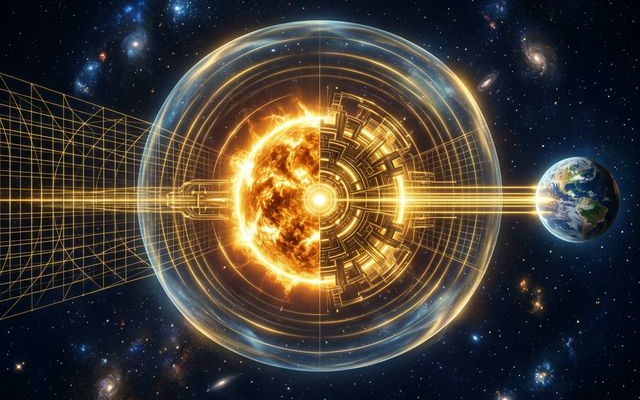
Within this architectural model, the Sun is the central node that simultaneously performs four critical functions: it holds the gravitational framework of the entire system in place (Storage / Stability), sets the basic rhythms for the periphery (Clock), provides a unified channel for energy and observability (Bus), and forms a protective envelope within which a stable operating regime is possible (Firewall).
And if that description works—if it does not contradict the facts—then a deeper formulation follows from it naturally. A formulation no longer about metaphor, but about essence.
The Sun does not “control us” in any direct sense. It does not issue commands, does not think about us, does not make plans.
It does something else, something far more fundamental. It provides the basic conditions under which “we,” as a complex, self-organizing, thinking process, can exist at all. It makes the scene executable. It creates the environment in which the runtime of life is possible.
Armor / Important:
And this is where the meaning I put into the word “processor,” or “central computing node,” finally becomes clear. Not as a piece of silicon with pins, but as a thermodynamic processor—a node that continuously, for billions of years, converts the monstrous internal energy of a star into an ordered, structured flow on which the entire periphery lives and feeds. Everything we know and love.
06—Why Heat Here Resembles Entropy
And one final remark on this subject—almost a physical one. Inside any working computational system, any process, there is always a cost. Even the most elegant, most optimized computation is never free. Wherever work is being done, wherever energy is being transferred from one state to another, there is inevitably dissipation. There is heat. There is entropy—the unavoidable growth of disorder somewhere at the periphery.
This matters for my model because any stable, long-lived regime, any complex structure, requires a constant inflow of energy and an equally constant export of entropy. It must have an energy budget.
If the Solar System is a complex process unfolding across billions of years, if structures as astonishingly complex as life and consciousness arise and are sustained within it, then it must have a controller powerful enough to supply that budget. A node that allocates it.
And the heat we experience as sunlight and warmth is, in that sense, not “extra,” not some negligible byproduct. It is the necessary, unavoidable trace of the system’s work. It is the visible sign that the process is running.
Armor / Important:
The Sun does not simply “warm” us in the everyday sense. It creates the conditions under which complexity can exist. And together with those conditions, it produces an unavoidable side effect: the dissipation of energy. That is what makes it resemble not a light bulb, but a powerful server in an overheated server room. You do not see the code running on it. You do not know what tasks it is solving. But you can tell with certainty that the system is working—by the heat it sheds, by the constant unbroken regime, by the hum, if you like.
07—Transition to the Next Part
And yet, after this whole long assembly, after looking at the Sun from every side, after mass, rhythms, channels, and protection, one question still remains. A question that, by now, becomes impossible simply to “unsee” and forget.
If the Sun really does play the role of a central node, if it provides both power and signal, then what exactly does light do in our local scene? What is its precise function?
We are used to thinking that light simply illuminates. It makes objects visible. But what if that is only half the truth? What if light is not just passive illumination, but an active protocol? What if it is a constant, continuous polling signal, a ping that forces matter to “answer” with its properties—shape, color, texture, temperature?
And if light really does work like that kind of hardware ping, then what counts as the reply in this scheme? Reflection? Absorption? Secondary emission? The thermal response we feel on our skin? And how, out of all those replies—out of billions of photons reflecting every second from every leaf, every stone, every face—is the thing we call “experience of the world” assembled? Our coherent, unified picture of reality?
The next step—and it is the logical continuation of everything said so far—is to move from the image of “the Sun as a node” to an investigation of “light as a protocol.” As the very language in which the system communicates with itself and with us.
Armor / Important:
“If a metaphor does not help us think more clearly, we do not need it. Its only criterion is this: does it make the connections easier to see?”
Next: Compilation