The phrase “The Sun speaks” sounds risky. It immediately suggests something mystical: secret messages, hidden knowledge, meanings you can decode if you try hard enough. Any skeptic will raise an eyebrow at that.
So let’s get one thing straight from the outset.
Safeguard
Armor / Important:
When I say “the Sun speaks,” I do not mean that the star has a voice, thoughts, or any desire to tell us something. I use the word in the simplest, most practical, engineering sense. The way we say “the instrument says” when we read its output. The way we say “the alarm says” something when the siren goes off.
Light from the Sun carries structure. It has parameters that can be measured and distinguished. From those parameters, we can learn what is happening at the source. From the way light reflects off objects, we can learn what those objects are. That is the “conversation” here—not in words, but in physical quantities.
01—What It Means to “Change Parameters,” and Why That Matters
There is a word for this: modulation. Modulation simply means changing the parameters of a signal.
Imagine you switch on a flashlight and shine a steady beam. It is just light, nothing more.
Now imagine you begin to vary that light: a little brighter, a little dimmer, flashing rapidly, changing color. The moment those changes appear, so do sequence, pattern, and structure.
That is exactly how information is transmitted in phones, Wi-Fi, and fiber optics: by changing the parameters of a signal at enormous speed. The eye does not see it, but an instrument can read it.
Now look at sunlight. To us, it seems even and constant. But only to the eye.
In reality, its parameters—brightness, spectrum, polarization—are not perfectly fixed. They are always changing slightly, because something is always happening on the Sun.
There are flares. There are sunspots. Plasma moves. Magnetic fields shift. And each of those processes leaves its mark on the light that travels toward us.
Then, as that light crosses space and pushes through the atmosphere, new changes are imposed on it.
Armor / Important:
So sunlight is not just a uniform stream. It is a stream carrying the imprint of everything it has passed through: the imprint of the star’s state, the imprint of interplanetary space, the imprint of the atmosphere.
No one intentionally “wrote” those changes. They arose on their own, because that is how physics works. But for anyone who knows how to read them, they are information.
02—Spectrum as a Fingerprint
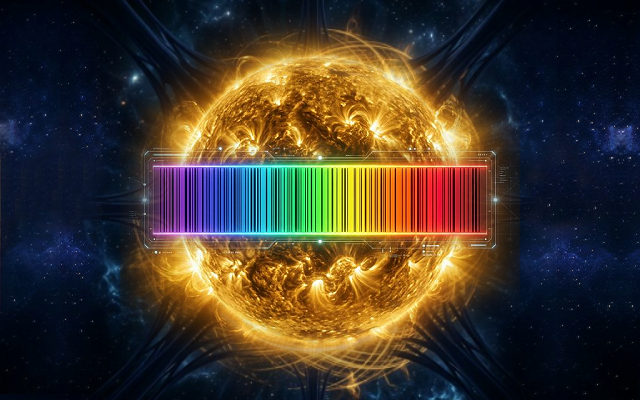
If you take sunlight and pass it through a prism, you do not just get a pretty rainbow. If you look more closely, you will see dark lines in that rainbow—sharp, clean, and fixed in place.
Physicists call them absorption lines.
They appear for a simple reason. The Sun’s atmosphere contains different atoms—hydrogen, helium, calcium, iron, and many others. Each type of atom absorbs light at very specific frequencies, very specific colors. So when light passes through that atmosphere, some of it gets absorbed at those frequencies. And here on Earth, we see dark gaps in the rainbow.
The position of those gaps is tightly tied to the substance itself.
Change the substance, and the pattern changes.
That is what I mean by a “signature.” Not in some hidden or encrypted sense. In the simplest possible one.
Armor / Important:
This is not a message. It is a trace. Any source with a composition and a temperature leaves this kind of trace in its radiation. It cannot help leaving it. It is like a fingerprint: it is there whether you meant to leave it or not.
And anyone who knows how to read that trace can learn a great deal about the star. Not because the star wanted to tell us, but because that is how light works.
03—A Simple Image: A Barcode on a Product
Here is a simple analogy: a barcode on a product. Black bars of different widths, white gaps between them. No text, no letters. The scanner simply reads the structure.
The solar spectrum is much the same. There are no letters, no zeros and ones, but there are dark lines at specific positions. Their placement, their depth, their width—all of that carries information: what the star is made of, what its temperature is, what is happening in its atmosphere.
This is not language. It is physics. The Sun is not deliberately encoding those lines for us to decipher. They arise on their own, simply because that is how physics is built. But to anyone who knows how to read them, they are information.
And for my picture of the world, that is exactly the point.
Armor / Important:
Light carries not only energy. It carries structure. And structure is something that can be distinguished, measured, and compared. At that point it is no longer just “fuel”; it is a carrier of information, even if no one intentionally put that information there.
04—The Pulse of a Star
There is another layer worth mentioning. It sounds poetic. In reality, it is measurable oscillation.
The Sun is not a frozen sphere. Inside it, things are always moving. Plasma churns, waves pass through, layers compress and expand, everything oscillates. The star quite literally “sounds”: it has its own internal rhythms, its own music. There is even an entire field devoted to this—helioseismology. By studying how the Sun’s surface trembles, scientists learn what is happening inside it.
Those internal rhythms—from rapid pulsations to the slow eleven-year activity cycle—do not vanish without a trace. They show up in the light that reaches us. Brightness shifts slightly, the spectrum shifts slightly, magnetic behavior changes slightly.
Armor / Important:
Which means our central node is not just some dull bulb burning steadily and without change. It is a living, breathing system with rhythms of its own. And those rhythms, those pulsations, are also written into the stream that reaches us.
And once you see that, the idea of a “master clock” expands. It is not only the alternation of day and night imposed by Earth’s rotation. It is also the inner pulse of the source itself. Two rhythms laid over one another: one from the motion of the planet, the other from the life of the star.
05—The Graininess of Light
There is one more thing worth saying. It connects what happens in the microworld to what we see around us every day.
To our eyes, light seems continuous. We look at a lamp and see a steady glow. We step outside on a sunny day and the world appears flooded with smooth, unbroken light.
That continuity is an illusion. An illusion created by the eye, because it cannot resolve the individual flashes.
At the quantum level, light is a stream of separate events. Billions and billions of photons every second, but each one is its own event. Like rain: from far away it looks like a solid wall of water, but look closely and it is individual drops.
The eye averages the stream and hides its discreteness. It merges billions of separate photon impacts into one smooth, continuous image. What we see is not graininess, but smoothness.
Armor / Important:
What we call “a bright sunny day” is actually the result of trillions of discrete micro-events every second. Our eyes simply cannot distinguish them one by one.
By day, the number of those events—photon strikes—is enormous. At night, it is millions of times smaller. And everything feels that drop in flux density: the eye, the skin, the leaf of a plant, even a stone that simply warms in the light.
That is how the quantum microworld, the world of individual photons, connects to large-scale regimes and ordinary life. The statistics of events invisible to the eye determine whether we work or sleep, grow or rest.
06—Flares and Sunspots: A Hint of “Interrupts”
One logical step remains. If light carries the imprint of the star’s state, and if the star has its own internal rhythms and pulsations, then sometimes those pulsations ought to become especially noticeable.
And they do.
Something is always happening on the Sun. Sunspots appear—dark regions cooler than their surroundings. Flares erupt—colossal explosions that hurl particles and hard radiation into space. Coronal mass ejections launch huge bubbles of plasma into the cosmos.
These are not mere “decorations” on the star’s surface. They are regime shifts. And those changes show up in the light that travels toward us, and in the particle flux that reaches Earth a little later.
We see the consequences: technology glitches, fields fluctuate, the atmosphere reacts.
But for me, the main point right now is something else.
Armor / Important:
1. Sunlight is not an empty, flat, meaningless background.
2. It has a complex structure: a spectrum in which the star’s composition is written, rhythms tied to its pulsations, and a flux density that changes from day to day.
3. Taken together, all of this is not just “light shining.” It is the imprint of the source’s current state, delivered to us through a channel.
This is exactly why I take the liberty of saying that the Sun “speaks.” Not in words, not in thoughts. But in the sense that any real source with a state inevitably leaves the imprint of that state in what it emits. And for anyone who knows how to read it, that is a signal.
A source’s radiation is never truly empty.
Any radiation is a trace of its state.
So the question is not whether there is a signal.
The question is whether we know how to read it.
07—Transition to the Next Scene
After all this talk about light carrying structure—having a spectrum, rhythms, its own inner pulsation—the next question arises. Inevitably.
What happens on the receiving side when the signal itself suddenly changes sharply?
The Sun is not a perfectly steady lamp. It has flares, spots, ejections. These are not just “interesting phenomena” for astronomers. They are moments when the signal abruptly changes shape. Moments when the stream reaching us becomes different—harder, faster, more chaotic.
And those jumps have consequences. We see them. Not in philosophy books, but in real life.
Burned-out transformers. Broken radio communication. Auroras where they had never appeared before. Navigation failures. And—who knows—perhaps something else as well, something we still have not learned to connect to these events.
Armor / Important:
“Speaks” means this: the stream contains distinguishable structure. Spectrum as the signature of composition, rhythms as operating modes, the grain of light as the statistics of quanta.
Next: What happens when the signal is disrupted. Flares, ejections, sunspots—as hardware faults at a node, and how they echo here on Earth.