In the previous piece, I argued that, at the fundamental level, gravity is not some invisible rope pulling one body toward another, but a curvature in the geometry of space itself. Bodies simply move along straight lines through curved space.
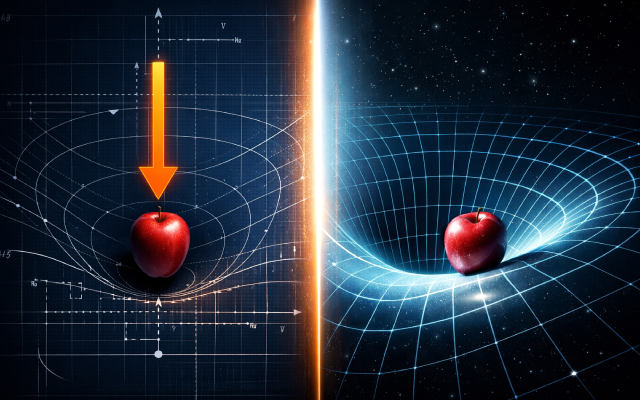
But if this is just geometry, a question naturally follows. Why, in ordinary life, do we experience it as a physical force? Why are we pulled so relentlessly toward the ground? Why do we feel heaviness when we hold a bag of groceries in one hand? Where does that sensation of “force” come from?
To understand that, we need to see how the deep architectural code of the Universe gets translated into everyday experience. How something that operates on the scale of stars and galaxies becomes something you feel every day.
01—The Safety Catch
Armor / Important:
To be clear, I am not invalidating school physics. The “force of gravity” model works beautifully—for apples, balls, and airplanes. There is no need to replace it with complex equations every time you just want to throw a ball through a hoop. For everyday life, it is a practical and accurate tool. Every layer of reality has its own language.
02—Why We Feel Gravity as a Force
I jumped—and came back down to the floor. I let go of a cup—and it fell and shattered. I set a heavy box on a table—and it pressed down on the surface. None of this feels like it needs explanation. We just know: there is a force that pulls downward.
At our scale—the scale of people, houses, and cities—the “force of gravity” model works extremely well. It is enough for all everyday calculations, from the flight of a ball to the load-bearing capacity of a bridge.
This model is enough to build skyscrapers. To calculate where a bomb dropped from an aircraft will land. To design bridges that do not collapse. To fly drones and sink a basketball.
For most everyday and engineering tasks, gravity is just a number. The acceleration of free fall, which physicists denote by the letter g. At Earth’s surface, it is about 9.8 meters per second squared. And it always points “down.” Vertically. For practical purposes, that is enough.
03—Within a Room, Everything Is the Same
Within the scale of your room, your house, or even an entire city, gravity changes so little that, in daily life, the difference is negligible. We live inside a convenient local zone where gravity is effectively the same everywhere. No matter where you stand in your apartment, an apple will fall at the same rate. The field seems smooth, flat, uniform.
But move a little farther out, and the difference becomes visible.
Ocean tides are the clearest example. Vast masses of water shift because the gravitational field of Earth and the Moon is not the same everywhere. In some places the Moon pulls more strongly, in others more weakly. And the ocean responds to that difference. Water flows, rises, and falls.
This is not some hidden mechanism, but simply a difference in the gravitational field from point to point. In the language of general relativity, it is a difference in the geometry of spacetime. Even if that difference is invisible inside your room, it is still there. And on the scale of oceans, it becomes obvious.
04—Load Sensors: The True Origin of Weight
This is where my favorite shift in perspective happens. Think about it for a moment. What exactly do you feel when you stand on your feet and experience your own weight? It seems as though gravity is pressing down on you.
But that is not what is happening.
You do not feel gravity. You feel the support reaction. The push from the floor, the ground, the chair.
Here is how it works.
Your body, if nothing interfered with it, would go into free fall. That is its natural motion in Earth’s gravitational field. Straight toward Earth’s center. That is its geodesic path.
But the floor gets in the way. It does not let that motion continue. Through electromagnetic repulsion between atoms and quantum exclusion effects, the floor delivers a hard refusal: “No farther.”
A support force appears. The body would fall freely downward, but the floor continuously blocks that motion. And this does not happen once. It happens continuously, every second you remain standing.
What you call “weight” is the stress in your bones, joints, and muscles caused by that constant collision. Weight is not some internal sensor measuring “how much gravity has been poured into you.” It is a measure of how strongly a surface is preventing you from falling.
Armor / Important:
This leads to a surprising, almost paradoxical conclusion: in free fall, weight does not exist.
Astronauts on the ISS float in weightlessness not because gravity has somehow been switched off. At the station’s altitude, gravity is still very strong—only slightly weaker than at Earth’s surface. But the astronauts do not feel weight. Why? Because the support has disappeared. The station and the astronaut are falling together. Along the same orbit. Falling endlessly around Earth.
There is no floor resisting that motion. No conflict. No load on the body. And so—weightlessness.
05—Two Truths at Once (Levels of Scale)
Within systems thinking, there is no conflict between physicists and engineers. No argument over “who is really right.” I can comfortably hold both models in mind, because they answer fundamentally different kinds of questions about the System:
- For life and engineering: gravity is usefully described as a force. It is a simple and reliable language for calculation.
- For deep physics: gravity is the geometry of spacetime. Orbit and falling are natural motion within that geometry.
It is like using online maps. You need one scale to get from home to the nearest supermarket, and a completely different scale to understand what planet this city is on—and in what geometry it was built in the first place.
06—Final Assembly
I keep the everyday “force” model in my toolkit as a reliable working instrument. It is not childish. It is purely pragmatic.
But when I need to understand the architecture of the engine itself—why the world is built this way rather than some other way—I switch to a deeper layer of description, where “down,” “straight,” and even the passage of time are defined by the geometry of spacetime itself.
Next: Gravity governs the macroscopic world, but at the level of atoms it is catastrophically weak. So what keeps matter from falling apart? What physically “stitches” our world together at the microscopic scale? Next we look at the fundamental interactions and the network protocols of the Universe.