In any serious discussion, there comes a moment for a direct, hard question:
“You keep using IT language and building an entire IT-style architecture around the Sun. Is that actually legitimate from a physics standpoint? Or are these just elegant metaphors with no real connection to reality?”
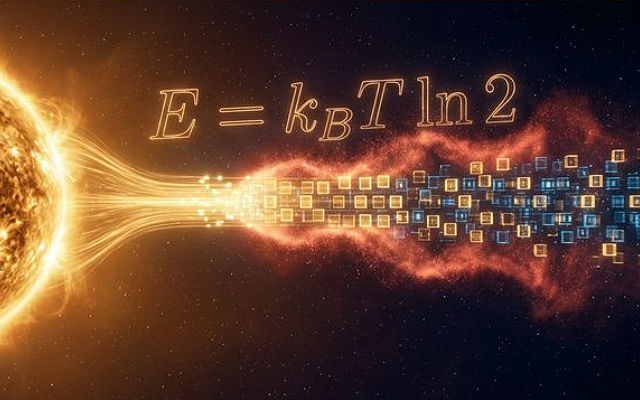
The question is so fair that if you do not answer it honestly, there is no point in going any further.
So here it is. If you think it through carefully… yes, it is absolutely legitimate. Not as a metaphor, but in substance. And here is why.
Armor / Important:
Information is not some mystical substance, not a spirit hovering above matter. It is a very concrete way of describing a system’s ability to distinguish between states. To tell hot from cold, light from dark, one from zero. And here is the crucial point: this distinction of states, this ability to tell one thing from another, has a physical cost. It must be paid.
01—The Cost of Erasure: Landauer’s Principle
In thermodynamics, in the branch concerned with the physical foundations of computation, there is one remarkable result. Its value lies precisely in its sobriety, its groundedness. No mysticism—just hard numbers and hard relations.
Its core idea is simple. Imagine you perform an operation on information that cannot be reversed. For example, you erase one bit of information. Before the operation, it is unknown what was stored there: a zero or a one. Afterward, it is guaranteed to be zero. You have reduced uncertainty; you have “imposed order.”
Landauer’s principle says that for such an erasure, for such a reduction of uncertainty, you have to pay. You must export the resulting entropy, the resulting disorder, somewhere outside the system. And at the physical level, that export appears as heat dissipation.
There is a lower bound on that cost. The energy that must inevitably be dissipated when one bit of information is erased is proportional to the temperature of the environment into which that heat is dumped:
$$E \ge k_B T \ln 2$$
In this formula:
- $k_B$ is the Boltzmann constant, the fundamental constant linking temperature and energy;
- $T$ is the ambient temperature in kelvins;
- $\ln 2$ appears because we are dealing with a binary choice.
That is Landauer’s principle: rigorous, derived from thermodynamics, and confirmed experimentally.
At room temperature, the minimum cost of erasing one bit is tiny—on the order of $3 \times 10^{-21}$ joules. A real processor in your laptop dissipates millions of times more energy per operation. But the minimum itself—the fundamental impossibility of erasing information for free—is real.
Armor / Important:
To create order in information somewhere, to reduce uncertainty, you must pay physically. You must dissipate energy. You must release heat. Even if you do it with perfect efficiency, there is still a cost, and its lower bound is set by temperature. Information has physical weight.
02—What “Information” Means Here
It is important to be clear about what kind of information is meant here. This is not “meaning” in the elevated human sense. It is a purely technical, quantitative measure: the number of possible states of a system.
One bit means two possible states: zero or one. That is its “informational content”—the ability to distinguish between those two alternatives.
Erasing a bit means forcing the system into one predetermined, known state. You have just reduced the number of possibilities. Where there were two, now there is one. So by the logic of physics, that lost “choice” has to show up somewhere else. It shows up as an increase in disorder, in entropy. And entropy exported outward is heat.
03—Why This Matters for My Project
Why bring Landauer’s principle and the thermodynamics of computation into a discussion about the Sun and light?
Because I want the bridge between words like “flow,” “signal,” “data,” and “telemetry” and the actual physical processes beneath them to rest not on poetry, but on honest, hard logic. Here is that logic.
First point. Any signal in the real physical world is always carried by some material substrate. There is no signal without a carrier. Light is a flow of photons. Sound is vibration in air. There is no pure, disembodied information.
Second point. Any operation on a signal—transmission, processing, filtering, storage, erasure—is a physical process. You cannot simply “think” or “transmit a thought” without involving matter. And every physical process has an energetic footprint. It has a cost. Landauer’s principle is simply a precise statement of that cost in one particularly simple case. And if this is true for a bit in a computer, why should it suddenly cease to be true, say, for a photon arriving from the Sun?
Third point—the conclusion. So when I describe the Sun as a central node emitting a flow that carries both energy and signal, I am not performing some forbidden anti-scientific trick. I am simply stating a fact: this flow physically encodes information about the state of the source and, through reflection, about the state of the world. And for that information to be read, processed, and used out on the periphery, energy is required—the very energy that arrives in that same flow.
Armor / Important:
The flows I am talking about are physical processes. The informational operations built on them cannot be separated from their physical implementation. They will always cost energy. They will always leave a thermodynamic trace.
04—How This Brings Us Back to the Sun
Now we can connect this back to the main theme: the Sun. Let us just walk through the chain.
Step one. The Sun emits an enormous outward flow of energy.
Step two. As that flow reaches the “clients”—the planets, the Earth—it causes an immense range of changes. It heats surfaces, drives chemical reactions, creates gradients of temperature and pressure, sets the atmosphere and oceans in motion, and establishes the rhythms of living systems.
Step three. And wherever there is a stable flow lasting billions of years, and wherever there are stable, recurring regimes arising in response to that flow, the language of “signal” inevitably becomes available—as a way of describing structured influence.
If you look closely, the flow from the Sun is structured. I think it matters to say that out loud. It has not just “strength,” but clearly distinguishable parameters: intensity, spectral composition, rhythm—day, night, day again. And when that structure falls upon a complex periphery ready to receive it—the atmosphere, the oceans, the biosphere—what does it become? A signal? That is a strong word. Let me be more careful: it becomes a condition under which the periphery learns to live. But if the periphery has organs capable of making distinctions, then for that periphery, this is precisely what a signal is.
The Sun’s flow is the energy that powers all processes on the periphery, including the ones in which information is erased, written, overwritten, and processed. The Sun creates the very gradient that sustains complex, non-equilibrium structures. And those structures, in turn, become capable of distinguishing states, processing “signal,” and paying the energetic price for doing so.
Armor / Important:
The Sun emits a flow that carries structured influence. The presence of that structure makes two fundamental things possible: the synchronization of processes on the periphery and the observability of the scene for any system capable of distinguishing that structure.
05—Transition to the Next Scene
Once we have established that distinguishing states has a physical cost, we can ask the next question—a question that takes us to an even deeper layer of the architecture.
We have talked about the pipeline: about how hydrogen turns into helium, releasing energy. But if you pause and think about it, there is one enormous oddity in this process—something physics explains perfectly well, but which, through this architectural lens, can be seen in a new way.
Hydrogen nuclei are protons. They carry the same positive charge. Which means they should repel each other violently. Classically, it is both energetically unfavorable and effectively impossible for them to get close enough for the strong interaction to turn on and fusion to occur. Classical physics says they simply do not have enough energy for that at the temperatures present in the Sun’s core.
And yet fusion happens. Steadily. Calmly. For billions of years.
How is that possible? How is this “admission” to the reaction implemented in the core of a star? Not by brute force, not by simply smashing through the barrier, but by some other mechanism?
Physics gives the answer: quantum tunneling. A purely quantum phenomenon with no true analogue in the macroscopic world. A particle has a nonzero probability of appearing on the other side of an energy barrier it has no classical ability to overcome. As though there were an invisible passage available to it.
And here, if I allow myself to go that far, an unexpected turn opens up. At first it looks like a mere quantum curiosity—so particles sometimes pass through walls, fine. But if you think about it, if you do not rush…
This is not a bug. It is an access mechanism built into the system. An invisible gate that opens with a certain probability exactly where brute force is powerless. And without that mechanism, not a single star would ever have ignited. And we would not exist.
Armor / Important:
“Information is not a mystical substance. It is a way of distinguishing states. And distinguishing states has a physical cost.”
Next: Tunneling as an enabling mechanism. A nonzero amplitude on the far side of the barrier—and why that naturally lends itself to the language of a “gate.”