Visually, the Universe—with its stars, nebulae, and galaxies—is breathtakingly beautiful. But if you look under the hood and run the numbers in cold physical terms—actual masses and energies—an architectural oddity appears: there is far too little visible matter for this enormous structure to hold together at all, let alone function the way it does.
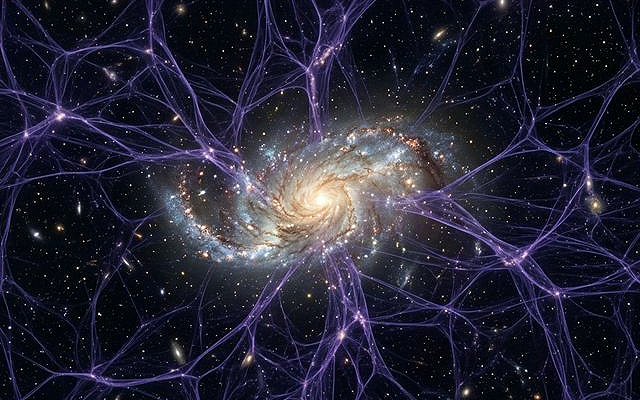
Ordinary, tangible, luminous matter—baryons, the stuff that makes up us, the Earth, and the Sun—accounts for only about 5% of the Universe’s total energy density. The remaining 95% is hidden from all of our basic electromagnetic sensors.
From an engineering point of view, this is perfectly normal. The heaviest and most functionally important processes almost always operate outside the visible scene.
Welcome to the invisible part of the system.
A Safeguard for the Skeptic
Armor / Important:
When I speak of a “hidden framework,” “the scaling of the medium,” or a “boundary of resolution,” I am using a systems lens. That does not mean we literally live inside someone’s deliberately designed server—a simulation. Science is quite open about the fact that the true nature of the dark sector remains unknown, and telescopes such as Euclid are now collecting data to constrain dark matter through observation.
I use systems metaphors not for conspiracy-minded speculation, but to make these scales a little more intelligible through familiar structures.
01 — Dark Matter: the Hidden Framework
Let us begin with a fact, without poetry. If you take a typical spiral galaxy and calculate the mass of all its visible stars and gas, you run into a hard mismatch: the outer regions of the galaxy rotate too fast. Under the laws of gravity, with so little visible mass, the system should have flown apart. But it remains intact. More than that, clusters of such galaxies have enough total mass to bend passing light through gravitational lensing, even though there are plainly too few visible objects there to account for the effect.
Whatever produces this vast unaccounted-for gravitational mass, physicists call “dark matter.” We do not see it. It does not emit or absorb light in any way noticeable to us. In fact, it does not register through our familiar observational interface at all, except via gravity.
Through a systems lens, dark matter functions as an invisible load-bearing framework. In any complex structure, the visible form may catch the eye, but the actual mechanics often rest on unseen supports.
Armor / Important:
The large-scale rigidity of the cosmic scene is sustained by something that does not appear directly in the observable picture, yet firmly sets the spatial scaffolding for visible matter. It is structural reinforcement holding clusters together.
02 — Dark Energy: the Expansion of the Medium Itself
The second fact is even more counterintuitive: the Universe is not merely sitting there in a static state. The metric of space itself is expanding—galaxies are receding from one another—and this expansion is accelerating over time. The unknown cause driving that expansion against gravity has conventionally been labeled “dark energy,” which makes up about 68% of the total energy budget.
Through a systems lens, the simplest way to picture this is not as objects flying apart through a preexisting emptiness, but as the medium itself expanding. In the standard cosmological model, ΛCDM, this effect is described by the cosmological constant, Λ—a placeholder for accelerated expansion.
Space changes its own metric:
- distances between far-flung regions increase;
- the geometry of the medium itself changes over time;
- objects can end up farther apart not because they are “moving through emptiness,” but because the very fabric of distance is stretching.
Armor / Important:
This does not mean space is being “built out” like warehouse floor space. The point of the systems lens is different: the medium can dynamically change its own metric and volume without violating the rules of local gravitational interactions.
03 — Vacuum: Not Emptiness, but a Ground State
Everyday intuition craves simplicity: vacuum means absolutely nothing is there.
But quantum field theory breaks that stereotype. Physically, vacuum is not the absence of everything; it is the ground energy state of quantum fields, immensely complex in its own right. Popular explanations often describe it as an endless seething of virtual particles appearing and disappearing through zero-point fluctuations.
Through a systems lens, vacuum is better understood not as empty nothingness, but as an already defined background state. It is not the absence of everything, but a medium with properties of its own, even when no visible stable particles are present.
Vacuum is not zero. Vacuum is “on.”
04 — 5% Visible, 95% Hidden
The human ego often recoils: “Why does the Universe need so much hidden content? Why do we—ordinary tangible matter—make up only 5% of the total budget?”
In the language of complex systems, the answer is cold but clear: in large distributed systems, this is entirely normal.
What is available to direct observation is always only a tiny part of a complex system. The interface is local and compact. The hidden load-bearing layers are far more massive—and far more important.
The more elegant and seamless the visible scene is—stable planetary orbits, fusion in stellar cores, the formation of molecules—the more heavy, unglamorous infrastructural work is distributed across the foundational layers. In cosmology, under the ΛCDM model, about 95% of the Universe’s energy density belongs to precisely those hidden components that we detect only through their indirect gravitational scaffolding and the effect of expansion. This is not some human-centered design whim. It is the actual architectural balance of the physical environment in which we evolved.
05 — Black Holes: the Boundary of Analysis
IT enthusiasts often overload cosmology with overly literal analogies, claiming that the supermassive black holes at galactic centers are “cosmic garbage collectors” or hidden control hubs. At that point, imagination needs a limiter, and physics needs to take back the wheel.
Yes, the visual resemblance is striking: a galaxy is a vast distributed cluster of nodes—stars—rotating around a single central supernode of extreme mass.
But physically, a black hole is not a trash bin. In our interface-level view, it is a hard boundary where our familiar classical language of description reaches its limit.
The event horizon is, quite literally, a boundary of informational accessibility for us as outside observers. Here reality approaches its maximum computational density—hence the appeal of ideas like the Holographic Principle. Beneath that horizon lies the singularity: the point at which our mathematical description, in its current form, breaks down. We simply do not yet possess the tools to describe physics at such extreme densities.
06 — Calm in the Face of the Unknown
We do not have to fall into mystical dread before the Dark, and we do not have to deny the physical fact that observable mass is insufficient.
The architectural lens allows for a more mature stance. We can calmly acknowledge that 95% of the Universe’s mass-energy lies in a hidden layer of reality. And instead of reacting to that mystery with primitive awe, we can respond with an engineer’s respect for the power of mechanisms that quietly and reliably sustain our small, light-filled visible layer of the world.
Armor / Important:
Next: THE AGENT. The human being as a local node in the system. The macroscopic scales are now in place; we can descend to the level of the terminal device—to how the human being operates within this architecture.