If the Sun is the central server, continuously streaming traffic, and Earth is an active client terminal, assembling structural complexity from that flow, then the system may seem complete. But any data center or complex station often has external hardware attached to it—modules that do no computing of their own, yet without which the main node would eventually drift out of control.
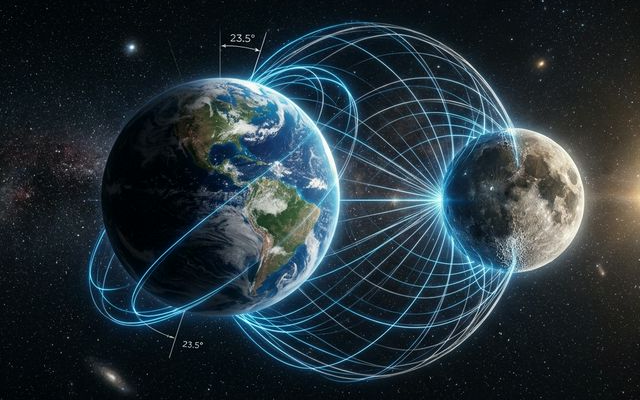
In our architecture, the Moon is not just a romantic rock in the sky, there to inspire poetry. Seen in strictly engineering terms, it is an important auxiliary stabilization node.
Safeguard
Armor / Important:
I am not claiming that some intelligent agent “built” the Moon as a spaceship or artificially dragged it into orbit. We are looking only at its function. In complex evolving systems, elements that accidentally or systematically provide stability become architecturally fixed.
The Moon performs several important physical tasks, but one of them matters especially: it helps preserve Earth’s long-term, predictable operating mode. Without it, today’s extended regimes of climatic and biological stability would be noticeably more fragile.
01 — The Moon’s main function: stabilizing Earth’s axis
The Moon’s main infrastructural function is the long-term stabilization of Earth’s axis.
Earth rotates with a tilt of about 23.5 degrees. Without a massive nearby satellite, that tilt would not be stable: it would wander under the gravitational influence of other planets, especially Jupiter. The axis would wobble and drift into extreme ranges.
Armor / Important:
From a systems perspective, this would be catastrophic for Earth’s entire living environment.
There would be no predictable seasons. Climate zones would shift dramatically, with large swings over timescales of millions of years.
For the biosphere, that would mean constant critical environmental failures—a continuous chain of climate disruptions forcing the system to spend an ever larger share of its available resources on compensating for instability rather than building longer chains of complexity.
In systems terms, the Moon functions as an external gravitational gyroscope. Its mass “anchors” Earth’s tilt. It provides a hardware-level guarantee that the planet’s baseline conditions will remain sufficiently reproducible and predictable over hundreds of millions of years.
02 — Moonlight at night: weak support for rhythm
We remember that sunlight is the primary channel of energy and visible signal. But Earth rotates (so it doesn’t burn up on one side), and at night, direct light from the Sun is cut off. The planet moves into shadow, processes slow, and the environment enters its nighttime operating mode.
But for some living systems, night does not become a complete visual blackout.
Armor / Important:
In this sense, the Moon works as a passive mirror.
It reflects a small fraction of sunlight back onto Earth’s night side.
Yes, this is a very weak light stream. It is “cold,” and far too weak for energy-intensive processes like photosynthesis. For the biosphere, it is not a critical system so much as a faint supporting signal. Stars and atmospheric glow do not leave the night absolutely dark, but the Moon increases illumination by orders of magnitude. This faint moonlight helps support nighttime navigation, biological rhythms, and the behavior of many animals.
03 — Tides as additional environmental mixing
Earth has a gigantic reservoir of heat, chemistry, and motion: the ocean. But if the water simply sat in its basin-reservoirs, it would inevitably stratify into layers. Without constant dynamics, exchange between layers and coastal zones would be weaker, and many zones of chemical and biological exchange would be less active. Complex life assembles more readily where the environment is constantly being mixed.
Through its gravitational field, together with the smaller contribution of the Sun, the Moon generates tides—the periodic rise and fall of water masses.
In systems terms, this is an additional mechanism for environmental mixing. Yes, the main global mixing of the ocean is driven by thermohaline circulation and atmospheric winds. But twice a day, the Moon’s gravity regularly moves water through coastal zones and shallow waters, where life is thought to have originated. This is an added physical factor that strengthens the transport system, sustaining exchange along shorelines and in shallow regions critical to early chemistry and biology.
04 — The Moon as a log of ancient impacts
If you look at the far side of the Moon—and even the visible side through a telescope—it is densely scarred with craters. People sometimes say that the Moon serves as Earth’s “shield,” but that is too crude a simplification. Because of its enormous mass and deep gravitational well, Earth attracts far more cosmic debris.
The difference lies in how Earth and the Moon preserve the traces of impacts.
Earth constantly reformats its own surface, erasing those traces.
Armor / Important:
The Moon, by contrast, is geologically far less active and therefore much worse at erasing them. It has almost no mechanisms that can quickly wipe away old scars.
That is why the satellite functions as a hard archive of ancient collisions. A significant share of external impact events, asteroid strikes, and cosmic incidents over billions of years has been permanently imprinted on its solid surface. Small traces degrade over time, but large structures persist across immense timescales. By looking at the Moon, we are literally reading a log of what has happened in our cosmic neighborhood since its launch.
05 — Interface bonus: the total solar eclipse
And finally—not an infrastructural function, but a rare interface coincidence, important not for the system’s stability but for the observer living inside it.
The Sun is about 400 times larger than the Moon in diameter and about 400 times farther from Earth. Because of this, the two appear in our sky at almost exactly the same angular size, making possible a perfect total solar eclipse, when the Moon’s disk covers the Sun’s photosphere millimeter for millimeter, revealing only the corona.
We do not have to call this some mystical “programmer’s design.” Astronomers know that the Moon is slowly moving away from Earth, at about 3.8 cm per year, and this perfect coincidence is only a temporary window in the planet’s long history.
But from an interface point of view—for us, as observers inside the current version of the system—it is a rare coincidence of apparent size. In our sky, the Moon geometrically overlaps the Sun, producing one of the most powerful effects of synchronization—and awe—in the observable world.
06 — Bridge to the Quantum Engine
We have assembled the macro-level of this architecture.
We already have a central resource source, a receiving planet, a light channel, and an auxiliary stabilizer near Earth. And we have a local traffic audit: the Law of Energy Consumption.
The macro-architecture is now in place. At the scale of orbits and celestial bodies, it looks almost perfectly mechanical.
But if we move the camera closer and look inside matter itself—inside what the Sun, the Moon, and we ourselves are made of—we run into a problem: the Newtonian logic of planets stops working. At the deepest level of reality, entirely different laws take over.
Armor / Important:
“At the macro level, the system looks like the perfect mechanics of orbits. But descend one layer lower, into the fabric of physics itself, and we find an engine where particles can be everywhere and nowhere at once.”
Next: The Quantum Engine. How the Universe optimizes rendering, why matter remains “smeared out” until the moment of observation, and how hardware-level resource economy works.